

Best Home Battery Storage in Scotland (2026): Which System Suits Your Home?
Compare home batteries for Scottish homes, including Tesla and Sigenergy. Understand costs, tariffs, backup power, VAT and what to check before buying.
Best Home Battery Storage in Scotland (2026): Which System Suits Your Home?
Information checked: 22 September 2026.
Which battery's best? Fair question, and the annoying answer is it depends what you want it doing. Cheaper bills, keeping the lights on when the power goes off, or both. The biggest one, the cheapest one or the one with the longest warranty on the brochure, none of that settles it on its own.
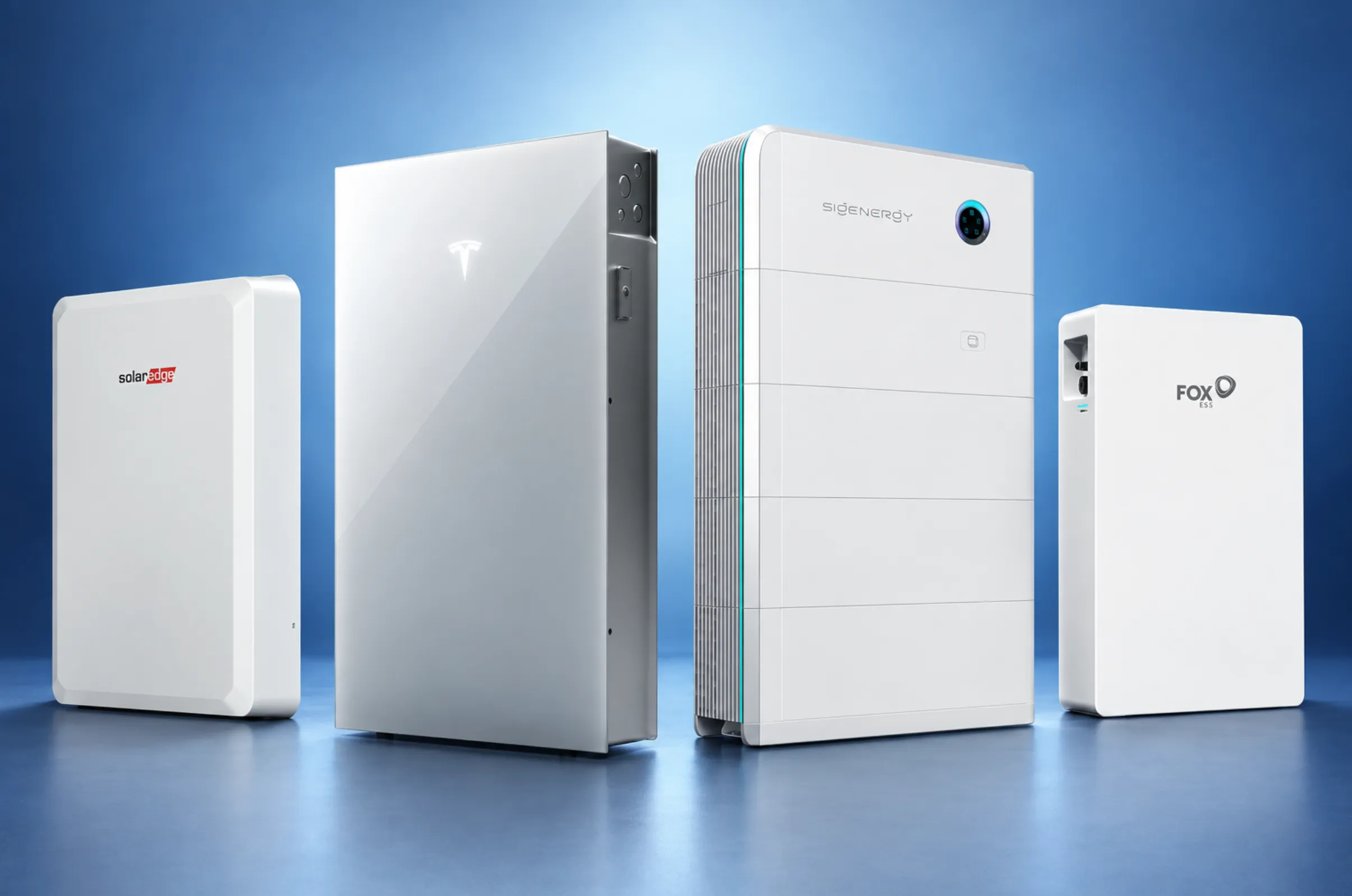
If it's a new solar and battery job we'd be putting Tesla Powerwall and Sigenergy SigenStor in front of you to compare, both bring the battery, the solar conversion and the controls together in the one system. Already got panels on the roof? Then an AC-coupled battery, or one that'll work with the inverter you've got, may be the more sensible place to start.
And the brand's only part of it. Your tariff matters, where the thing's going to sit matters, whether you want backup, who's actually standing behind the product if it goes wrong.
We install home battery storage across Central Scotland. A couple of the systems below we don't fit ourselves, they're in because you'll come across them and they're worth weighing up against the ones we do.
Quick Answer
Home batteries worth comparing
No league table here, because the right battery for a new build in Dunblane can be the wrong one for a farmhouse with ten-year-old panels. None of this is independent lab testing either, it's how the systems are designed and what the manufacturers say they'll do.
Tesla Powerwall
Powerwall is the one most people have heard of. Battery, a built-in solar inverter and the Tesla app all in the one unit, so if you're doing solar and storage together and you'd rather not be piecing separate components together it makes a lot of sense. We've fitted them in Dunning, at The Arns and in Dunblane.
Now the backup, because it's easy to miss. Tesla's UK documentation allows for backup and non-backup installs, so a Powerwall on the garage wall doesn't mean the house stays on when the power goes. For that you need the gateway, the electrical work that goes with it and the whole thing commissioned properly, and all of it on the quote. The Dunblane one has the backup gateway fitted, that's the setup you'd be wanting if power cuts are why you're buying.
What to ask: Does this quote include working power-cut backup? Which circuits will it supply, and what loads can run together?
Sigenergy SigenStor
Loch Venachar, near Callander. Solar panels, an EV charger, Sigenergy with a whole-home backup gateway, and the house already had a generator so we tied that in to carry it through the longer outages. It was designed round that house though, plenty of homes won't need a generator tie-in or whole-home backup.
What you're getting with SigenStor is a modular system, battery, power conversion and energy management built to work together, so it's one to look at when the plan's bigger than just a battery (solar, storage, maybe EV charging down the line). We've fitted Sigenergy at Cambuskenneth and here in Kinlochard too. Get any optional kit and any future expansion written into the spec, don't assume it. Ask what's included now, what can go on later, and what adding it would actually involve.
BYD Battery-Box
Not one we fit, but it turns up on other folk's quotes. The Battery-Box is modular and needs a compatible external inverter to go with it, and you can't judge one without the other because it's the pair of them that decides how fast it charges, how it's controlled and whether you get any backup at all.
So if somebody's quoting you BYD, the inverter they're proposing has to support that EXACT battery configuration. It won't just hook up to whatever solar inverter's already on your wall. Ask if the combination's approved, and who you'd actually phone about the battery and who about the inverter if something went wrong.
Enphase IQ Battery
AC-coupled, with the microinverters built in, going by Enphase's UK battery documentation. Handy if you've got solar already, since you can add the storage alongside it without automatically replacing your solar inverter. Still needs checked against your actual install mind.
Be careful with the videos online. A demo filmed overseas tells you nothing about which backup functions you'd get on a UK setup, so ask whether the proposed system keeps your existing solar kit and what backup's actually been confirmed for a UK install.
SolarEdge, Fox ESS and Growatt
These three we do fit, normally a hybrid inverter and battery chosen together when the solar's going on new. SolarEdge up at the Old Barn in Blair Drummond, and in Killearn and Doune. Fox ESS in Dunblane. Growatt too. Because the inverter and battery work as a pair you're comparing the whole package, not the badge on the battery.
Watch the warranties. Same brand, different model, different terms, Fox ESS's UK battery warranty has separate terms for different battery families, so don't take the warranty headline off one model and assume it applies to another. Or to the next generation of the same one.
What to ask: What are the exact model numbers, and can I see the UK installation and warranty documents before ordering?
Product and warranty documents:
- Tesla: Powerwall UK technical documentation, including backup and non-backup configurations; UK; checked 22 September 2026
- BYD: Battery-Box HVS datasheet; manufacturer document dated 28 March 2025
- Enphase: IQ Battery 5P UK datasheet; printed 21 September 2023
- Fox ESS: Battery Warranty UK, version 4.0; UK and Ireland; 1 May 2024
What's happened with GivEnergy
9 April 2026, GivEnergy Ltd went into administration. Six days later, on 15 April 2026, the administrator CB Business Recovery put out a statement saying the company had ceased trading and wouldn't honour any further hardware warranties. It was the Energy Storage Association that published it, and it's about the UK company.
That doesn't mean your GivEnergy battery's stopped working. The ESA separates the hardware company from GivEnergy Software Ltd (not every company in the group went into administration) and says working systems can keep running.
Got one already? Speak to your installer before you assume it needs replaced. Buying new, ask who would legally be providing the warranty and the support, because an old warranty headline on a website isn't enough. We don't offer GivEnergy on new installs anymore.
GivEnergy administration:
What size battery you need
Your electricity use. Not the size of the house, not the biggest battery on the price list, that's where sizing starts.
There's two numbers people mix up. Capacity is kWh, how much energy it stores. Power is kW, how fast it can charge or put it back out, so you can have a battery with plenty stored that still won't let you run the shower and the oven at the same time. And watch the spec sheets, manufacturers separate usable energy from other capacity figures, check which one you've been quoted.
Somebody sizing it properly wants to know when you use your electricity, how much solar you'll generate, what tariff you're on and whether there's an EV or a heat pump coming. Use your actual consumption data if you've got it. A house that burns most of its power in the evening needs a different battery from one that can shift a lot of it into the cheap hours.
Ask how much is being held back for power cuts too. Keeping a reserve is sensible, but that energy's just… sitting there waiting for an outage, it isn't saving you anything day to day.
Home battery storage cost in Scotland
£5,000 to £8,000. That's the Energy Saving Trust's figure for a home battery, in their solar panel guidance updated 27 August 2026. It's a UK number though, not a Scottish installed price, and it doesn't say what size of battery or whether VAT's in it. Fine for rough budgeting. Not a quote.
When you're comparing quotes get every installer to name the battery and its usable capacity, the inverter, the backup equipment, electrical work, installation and commissioning. The cheaper quote might just be covering less. And keep battery-only retrofit quotes away from solar-and-battery ones, the combined price swings with the size of the array and the roof and access, so lining the totals up side by side can mislead you.
VAT
0% until 31 March 2027 on qualifying domestic battery installs, and it covers more than you might expect. HMRC's guidance takes in a battery fitted with solar, a battery added to solar you already have, and a standalone battery charged off the grid, with the relief covering the qualifying materials your installer supplies plus the labour. Under current rules it's due to go to 5% from 1 April 2027, unless the legislation changes.
Buy the kit yourself and it's a different story, the retail sale's normally standard-rated even where the installation labour qualifies. UK rules, so they apply here the same. Get the VAT treatment written on the quote.
Cost and VAT:
Whether it's worth it up here
It can be. But the numbers have to work for your house, not some average one.
A battery stores spare solar for later, and it can also charge off the grid when electricity's cheap and run the house when importing would cost more. So no, you don't NEED solar panels to have one, though whether it suits you and what it saves comes down to the equipment, your tariff and how much you use.
The question worth asking is where the battery's energy is coming from, and what storing it saves you compared with the alternatives. With solar, allow for the seasons, a battery in Stirling in December isn't filling off the panels every day. On grid charging the gap between the cheap rate and the dear rate has to be big enough to cover the storage losses and still put something towards the install.
Don't forget export either. Solar sitting in your battery could've been exported and earned you something, so it's not worth the full price of the electricity you avoid buying later.
Energy Saving Trust's Flexible Futures analysis looks at tariff choice, equipment cost and financial return together, which is how you should be comparing them. Lower bills don't automatically mean buying more kit gets you the best return over its life.
Tariffs for a home battery
Octopus Flux is aimed at solar and battery homes. Go and Intelligent Octopus Go are EV tariffs, Intelligent needs compatible equipment, and a home battery on its own WON'T get you onto Intelligent Octopus Go. Cosy has qualifying electric-heating requirements. Agile's prices move about so you'd schedule the battery differently.
There's no best battery tariff for everyone anyway. Whether you're eligible, and what you pay outside the cheap window, matter as much as the overnight rate on the advert. Compare the expected whole-home annual bill across the ones that suit, daytime imports, export payments and standing charges all in. And don't buy a battery on the assumption one particular cheap rate lasts its whole life.
For more on grid charging there's our guide to battery storage without solar panels in Scotland.
Export payments
The Smart Export Guarantee is for eligible generation, a qualifying solar installation say. A battery charged off the grid isn't a renewable generator on its own, so whether you'd get paid for grid electricity you store and export later is down to your supplier's terms, not a headline export rate. Get them to confirm it for your setup before any export trading goes into the savings sums.
Tariffs, export and financial returns:
Battery payback
We wouldn't use a single Scotland-wide payback figure to decide whether your home should have a battery, and we'd be wary of anyone that does.
Doing it properly needs the installed cost, the usable capacity, your electricity use, expected solar generation, import and export prices, storage losses and how the battery's going to be run, plus which tariff assumptions are being held fixed. And it has to measure the extra saving the battery itself makes, which is the bit that's easy to fudge.
Say you move your EV charging into the cheap hours. That cuts the bill with no home battery at all, so the battery doesn't get the credit for it. Same with a combined solar and battery bill drop, it doesn't tell you what the battery saved on its own. Ask to see it against a sensible no-battery option, not just the final projected bill.
Backup can still be worth having even if it stretches the payback (we're based out at Kinlochard, we get it). Just count it as a separate benefit, don't dress what you spend on resilience up as guaranteed savings.
Battery grants in Scotland
Short answer, there's no general Home Energy Scotland battery grant open to every homeowner.
The Home Energy Scotland Grant and Loan terms dropped ordinary solar PV and energy storage from new application links issued after 6 June 2024, and adding a battery alongside a heat pump doesn't automatically bring that back. That one's a Scotland-only restriction. Warmer Homes Scotland is separate, assessed on the household and the property, and whether storage can go into an approved package has to be confirmed through the scheme, it's not an open battery grant. ECO4 got its GB-wide delivery deadline extended to 31 December 2026, but that doesn't mean every council's taking referrals or that you'd qualify for a battery.
Check eligibility and get approval before you order any work. Our Scottish battery storage funding guide goes through the different routes.
Scottish funding:
Home batteries in a power cut
Storing energy and keeping the lights on in a power cut are two different jobs, and a battery only does the second one if the whole installation's designed for backup. Tesla's UK documentation, for one, describes both backup and non-backup configurations. It's the gateway and the install work round it that make the difference.
So before you buy, work out what you actually need running. Lights, fridge, heating controls, that's one thing. The electric shower, the cooker and the EV charger all going at once is a whole other thing.
Get your installer to confirm the protected circuits, the continuous output, the switching arrangements and the expected runtime for an agreed set of loads. "Whole-home backup" doesn't mean unlimited power, or power for however long the outage lasts. Our emergency backup power guide goes into why all that has to be decided at the design stage.
Where the battery can go
Not the loft, for a start. PAS 63100:2024, the UK fire-safety spec for home batteries, lists loft and roof spaces as unsuitable locations, along with sleeping areas and escape routes. It favours outdoor installation where practicable and puts conditions on indoor siting, so ventilation, fire separation and the other protective measures all need thinking about. That doesn't mean every indoor install is banned mind, or that every existing indoor battery is illegal. PAS is a technical specification, not an Act of Parliament.
Outside has its own rules. An outdoor-rated battery still has to go in within the manufacturer's limits, temperature ratings, cold-weather performance, access, exposure, clearances, a waterproof box isn't the end of it. Some manufacturers specify reduced power at low temperatures even where outdoor installation's allowed.
Check the location before you settle on a product.
Scotland has its own building standards
Part P is England and Wales. Up here electrical work goes through Scotland's own building standards, and government guidance tells installers to check with the local authority's building standards service whether a building warrant's needed. Then there's the network operator side, some setups qualify for a G98 notification, others need a G99 application and approval before anything gets connected.
Flats and tenements are fiddlier. The assessment needs to cover the common escape routes, fire separation, access to the equipment and any permissions for the shared parts of the building, and a cupboard big enough to fit the battery isn't automatically the right place for it.
Siting, building standards and connection:
- BSI: PAS 63100:2024, protection against fire of battery energy storage systems for use in dwellings; UK; 20 March 2024
- IET: Part P, Scotland and Northern Ireland; page undated, checked 22 September 2026
- UK Government: Registering energy devices in homes or small businesses (G98/G99, and Scottish building standards); GB; 31 March 2021
What a good battery quote should show
Exact models. Usable capacity, charge and discharge limits, the backup arrangements, where it's going. If you can't read a quote and know what you're buying, what it's meant to do and what's left out, send it back and ask again.
And the UK warranty documents that apply, not just the number of years in a brochure. When you read the warranty look for retained-capacity promises, cycle or energy-throughput limits, registration requirements and who handles a claim, the documents go into a lot more detail than the headline period.
Savings estimate, ask what tariff and usage it's assuming. Funding claims should come with eligibility in writing. Backup, ask exactly which equipment and circuits are in.
Choosing a battery for your Central Scotland home
Got solar already? A retrofit that keeps the suitable equipment may make sense. Starting fresh with a new solar project there's more room to design the inverter and battery together. And if power cuts are the worry, backup needs designed in from the start, not bolted on after.
We design and install solar, battery storage and backup systems right across Central Scotland, Loch Venachar's just one of them. We'll look at the property and the equipment you're considering before we set out the scope of work.
Want a battery designed around your home?
Book a free battery storage survey to talk through your electricity use, any existing solar and whether your priority is lower bills, backup power or both. MCS certified installers covering Stirling, Falkirk, Perth and wider Central Scotland.
Frequently Asked Questions About Home Batteries in Scotland
Straight answers on choosing a battery, VAT, grants, backup power and GivEnergy.
Related Articles
Continue reading with these similar topics

Backup Power with Home Batteries in Scotland: Simple, Safe, and Actually Useful When the Lights Go Out
Straight-talking guide to home battery backup in Scotland: critical circuits vs whole-home, EPS island mode, PME earthing, G98/G99 compliance, BS 7671 safety, and what really works when power cuts hit.
Zero VAT on Home Battery Storage: The HMRC Rules, Real Savings, and What to Check Before March 2027
0% VAT on home battery installation currently runs until 31 March 2027. This guide covers the HMRC rules, savings maths for retrofit and larger domestic battery installs, smart tariff pairing, and what to watch before the window closes.
Home Battery Storage Scotland 2026: Costs, ECO4 Grants & 0% VAT
Home battery storage in Scotland for 2026: realistic costs (£4k-£10k+), ECO4 grant eligibility before it ends 31 December 2026, 0% VAT until March 2027, and why Home Energy Scotland no longer funds batteries.