

Zero VAT on Home Battery Storage: The HMRC Rules, Real Savings, and What to Check Before March 2027
0% VAT on home battery installation currently runs until 31 March 2027. This guide covers the HMRC rules, savings maths for retrofit and larger domestic battery installs, smart tariff pairing, and what to watch before the window closes.
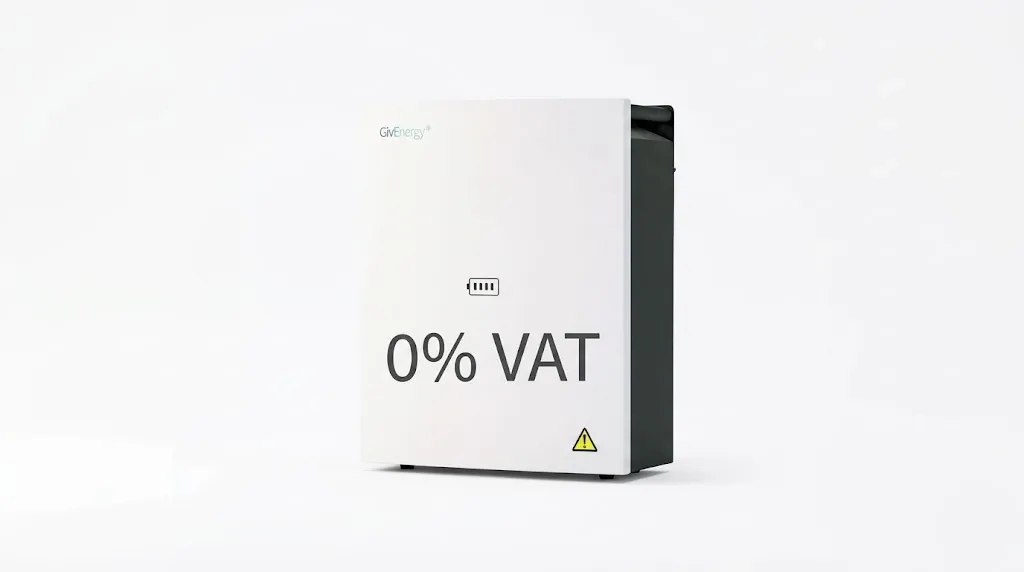
Zero VAT on Home Battery Storage: What It Actually Means and What to Check Before March 2027
The Quick Version
The HMRC Rule
In 2024, the government introduced legislation bringing electrical storage batteries within the temporary zero rate for qualifying residential energy-saving materials, alongside measures such as solar PV, heat pumps, and insulation.. The legislation is reflected in HMRC's VAT manual at section VENSAV3061.
What Qualifies
- Standalone battery installations — no solar panels required
- Retrofit batteries added to existing properties
- Batteries installed alongside new solar PV systems
- The battery unit, inverter, and associated installation labour and materials where they form part of the qualifying installation
- Residential properties only — the property must be used as a dwelling
What Does NOT Qualify
- Commercial or industrial installations — these generally remain at standard-rate VAT
- EV charger work — do not assume an EV charger shares the battery VAT treatment. It should be priced separately and the VAT shown clearly on the quote
- Work on properties used solely for business — a home office does not usually disqualify you, but a standalone commercial unit does
The Key Date
Under current HMRC rules, the temporary zero rate ends on 31 March 2027 and is scheduled to revert to 5% VAT from 1 April 2027 unless the law changes.
For most homeowners, the practical point is simple: get the installation finished and correctly invoiced within the zero-rate window. But VAT timing follows HMRC tax-point rules, and deposits can create their own tax points, so if your job is landing close to the deadline, get the VAT treatment confirmed in writing by the installer before you go ahead.
The Savings Maths
Scenario 1: 5kWh Retrofit Battery (typical single-battery system)
- Typical installed cost (before VAT): £4,500–£5,500
- VAT saving at 0% vs 5%: £225–£275
- VAT saving at 0% vs 20% (pre-Feb 2024 position): £900–£1,100
This size of battery paired with a time-of-use tariff such as Octopus Flux can save roughly £250–£350/year through grid arbitrage alone, depending on the tariff spread and how consistently the battery is cycled.
Scenario 2: 9.5kWh Retrofit Battery (larger single-battery system)
- Typical installed cost (before VAT): £6,000–£7,500
- VAT saving at 0% vs 5%: £300–£375
- VAT saving at 0% vs 20%: £1,200–£1,500
Larger capacity means more peak load shifting. Annual arbitrage savings can be roughly £400–£650/year in the right setup. Payback with VAT relief is often around 9–10 years from arbitrage alone, faster if paired with solar.
Scenario 3: 13.5kWh Larger Domestic Battery Install (e.g., Tesla Powerwall 3)
- Typical installed cost (before VAT): £8,000–£10,000
- VAT saving at 0% vs 5%: £400–£500
- VAT saving at 0% vs 20%: £1,600–£2,000
The Tesla Powerwall 3 combines battery and inverter hardware in one unit and can also provide backup-style functionality depending on the final design. Annual savings of £500–£800/year may be possible from arbitrage, rising materially when solar self-consumption is added into the mix.
Smart Tariff Pairing: Why the Battery Needs a Tariff to Work
A battery on a flat rate tariff usually will not give you much arbitrage value on its own. The real gains come from pairing it with a time-of-use tariff, solar, or both. And because Flux prices vary by region and change over time, treat every figure below as an illustrative Southern Scotland example — not a standing Scotland-wide price list.
Illustrative Octopus Flux Example — Southern Scotland (SP Energy Networks)
| Time Period | Rate | Type |
|---|---|---|
| 02:00–05:00 (off-peak) | ~15p/kWh | Off-Peak |
| 05:00–16:00, 19:00–02:00 (standard) | ~26p/kWh | Standard |
| 16:00–19:00 (peak) | ~36p/kWh | Peak |
02:00–05:00 (off-peak)
~15p/kWh
05:00–16:00, 19:00–02:00 (standard)
~26p/kWh
16:00–19:00 (peak)
~36p/kWh
Peak-to-off-peak spread: roughly 20p/kWh. That spread is where the arbitrage value comes from.
How the Maths Works on Flux
Charge a 9.5kWh battery overnight at ~15p/kWh = about £1.43 to fill.
After roughly 10% round-trip losses, usable discharge is about 8.55kWh.
If 4kWh is used during the 16:00–19:00 peak window (avoiding ~36p/kWh) and 4.55kWh during the standard window (avoiding ~26p/kWh):
- Peak avoidance: 4 × 36p = £1.44
- Standard avoidance: 4.55 × 26p = £1.18
- Total avoided cost: £2.62
- Net daily benefit: about £1.19/day
- Annual saving: roughly £430 from arbitrage alone
Add solar panels generating around 3,500kWh/year with decent self-consumption through the battery, and total annual savings can climb above £800–£1,100, depending on usage habits, export rates, and how the system is configured.
Flux Export (If You Have Solar)
Flux also pays for export, with peak export windows often paying materially more than standard export periods. If your battery is full and solar is still generating during summer evenings, that can help. But in most homes, self-consumption still wins — avoiding a high import rate is usually worth more than earning an export rate. Recheck live import and export prices before quoting any exact savings.
Who Benefits Most?
Existing solar PV owners — you're currently exporting surplus generation for far less than your peak import price. A battery stores that surplus for evening use, avoiding expensive grid import. Payback is usually fastest for this group.
EV owners on time-of-use tariffs — you're already buying cheap overnight electricity for the car. Adding a battery extends the same principle to the rest of the house: charge cheap, use later when rates are higher.
Homes without solar on time-of-use tariffs — even without panels, grid arbitrage can still save a few hundred pounds a year depending on battery size, tariff spread, and how disciplined the scheduling is. You do not need a south-facing roof to get value from storage.
Rural or outage-prone properties — a battery system can keep essential circuits running during power cuts, but only if backup or EPS functionality is included in the final design. That matters more in rural Scottish areas with overhead lines and rougher weather exposure.
What About Feed-in Tariff Customers?
If you're on the legacy Feed-in Tariff (FIT), adding a battery will often allow your existing arrangement to continue — including deemed export in many common domestic setups — but it is not something to assume blindly. Ofgem's co-location guidance is clear that storage must be declared properly and the metering rules still have to be met.
In plain English: many FIT customers can add battery storage without wrecking their payments, but you should notify your FIT licensee and have the setup checked against current guidance before the install is signed off.
The Installation: What Actually Happens
Pre-Install Survey
We check:
- Consumer unit — spare ways, RCD/RCBO protection, board age and condition
- Meter tails and service fuse — capacity for the additional battery inverter load
- CT clamp positioning — correct placement on the meter tails is critical for the battery to accurately read import/export
- Mounting location — garage, utility room, or external wall. Minimum clearances per manufacturer spec, ventilation requirements for inverter cooling
- Wi-Fi signal — the battery needs reliable internet for cloud monitoring, tariff scheduling, and firmware updates. If your Wi-Fi does not reach the installation location, we'll advise on a mesh extender or ethernet backhaul
Installation Day (Our Typical Domestic Install Is Around 4–6 Hours)
- Isolate supply at the meter
- Install Henley block or service junction on meter tails (if not already present)
- Mount battery and inverter on wall/floor
- Run dedicated circuit from consumer unit to inverter
- Fit CT clamp on meter tail
- Commission: connect to Wi-Fi, register on manufacturer portal, configure charge/discharge schedule for your tariff
- Test: verify CT clamp reads correctly, confirm battery charges and discharges on schedule, check the relevant grid-connection requirements
- Handover: show you the app, explain the schedule, and provide the relevant certification and documentation
MCS Certification
Where the installation is carried out under MCS, you should receive the relevant MCS paperwork for that system. MCS now has a dedicated battery installation standard, MIS 3012, which matters for quality assurance and future-proofing.
If you're planning to add solar later and want access to export tariffs, do not assume a battery-only install automatically covers every future requirement. The future solar system, product choice, metering, and installer certification still matter.
Funding Landscape (Beyond VAT)
Home Energy Scotland
For current applicants, funding for solar PV and energy storage is no longer available through the Home Energy Scotland Grant & Loan scheme. There was a transitional window for some earlier applicants in 2024, but that has passed. Funding is now focused far more heavily on heating upgrades such as heat pumps.
ECO4
The UK-wide ECO4 scheme can still involve battery storage as part of a wider retrofit for eligible households, but battery storage is not treated as a simple standalone scored measure. In other words, this is not a straightforward “free battery” route for most households. It tends to sit inside a broader package led by insulation, heating, or other qualifying improvements.
The 0% VAT Advantage
Unlike grants, the VAT relief requires no application, no eligibility check, and no means testing. It's automatic — your installer applies the correct VAT treatment and accounts for it through their VAT return. You do not need to do anything except make sure the job is quoted and completed properly within the current rules.
Why the Window Is Closing Faster Than You Think
The 31 March 2027 deadline is now less than a year away. That sounds like plenty of time, but consider:
- Survey-to-installation lead times can still run to several weeks
- Battery stock availability still moves around depending on brand and demand
- Consumer unit upgrades can turn a simple install into a two-stage job if not spotted early
- DNO approvals for larger or more complex setups can add extra delay
If you're thinking about a battery, book the survey now. Even if you do not install until later in 2026 or early 2027, having the survey done and a quote in hand means you can move quickly when you're ready.
Frequently Asked Questions
Common questions about the 0% VAT on home battery storage in Scotland.
Lock In 0% VAT Before March 2027
We survey, supply, and install battery storage systems across Central Scotland. NICEIC-approved, with any required remedial electrical work clearly costed in the quote.
MCS-certified battery installers serving Stirling, Falkirk, Dunblane, Bridge of Allan, Dollar, Bearsden, Alloa, and Central Scotland.
Related Articles
Continue reading with these similar topics
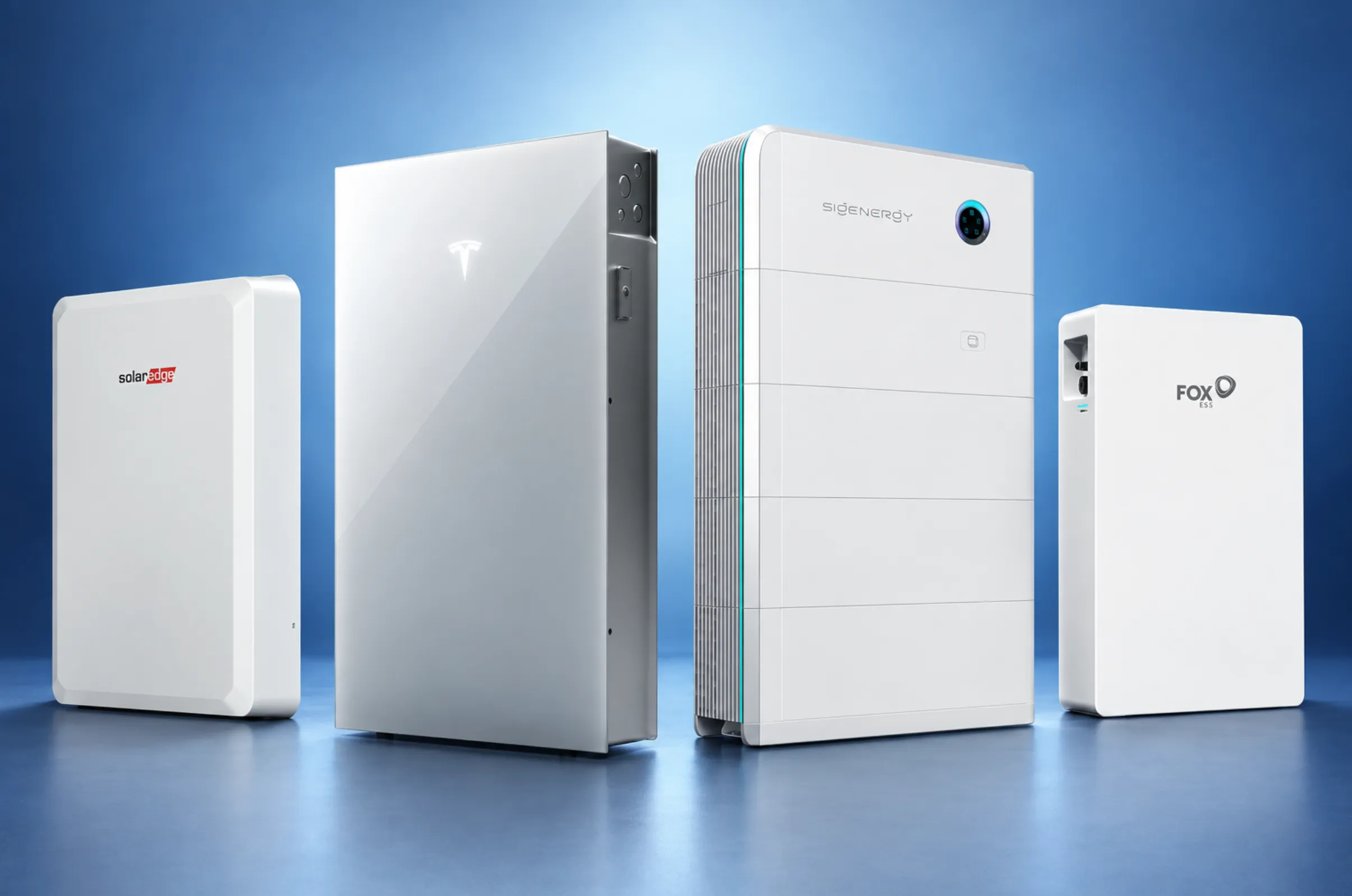
Best Home Battery Storage in Scotland (2026): Which System Suits Your Home?
Compare home batteries for Scottish homes, including Tesla and Sigenergy. Understand costs, tariffs, backup power, VAT and what to check before buying.

Home Battery Storage Scotland 2026: Costs, ECO4 Grants & 0% VAT
Home battery storage in Scotland for 2026: realistic costs (£4k-£10k+), ECO4 grant eligibility before it ends 31 December 2026, 0% VAT until March 2027, and why Home Energy Scotland no longer funds batteries.

Octopus Flux vs Go vs Intelligent Go in Scotland: Which One Should You Actually Use?
Flux vs Go vs Intelligent Go in Scotland: which Octopus tariff suits solar, batteries and EVs? See live Southern Scotland rates, examples and installer advice.