

Is Plug-in Solar Legal in Scotland? The 2026 Answer
Plug-in and balcony solar still isn't legal to sell or use in the UK, but the government has now confirmed the route to change that. Here's the honest Scottish position as of July 2026.
Plug-in Solar in Scotland: Where It Stands Now
Before You Spend Anything
We came back to this on 18 July, two days after DESNZ published its answer. It still isn't legal to use one. What we have now is a firm yes from government.
Is It Legal Today?
If you phoned us today and asked if you could buy one and plug it in, we'd say no. That's the position on 18 July.
We keep seeing kits advertised as though the announcement in April settled everything. It didn't. The response on 16 July is good news and it tells us the government is going ahead, but saying you're going to change a law isn't the same as changing it. Right now the retailer isn't allowed to sell the kit and you're not allowed to use it. That's DESNZ's position, not us being overcautious.
So if a website takes £400 off you, all you've got is something that has to stay in the box. It may not be for long, nobody knows yet, but there isn't a start date and there's no point pretending otherwise.
What Do You Actually Get?
Usually two panels, a microinverter and the lead with the plug on it. The microinverter is the important bit. Panels make DC electricity, houses use AC, and the wee box changes it over. On the roof systems we install, that power is wired back to the fuse board. With this setup the cable goes to a normal socket.
Solar Only, No Battery
The official name for the whole kit is a 'plug-in microgenerator'. The route DESNZ has agreed only covers solar kits without storage. A plug-in battery, a battery added to the kit or a small wind system isn't included.
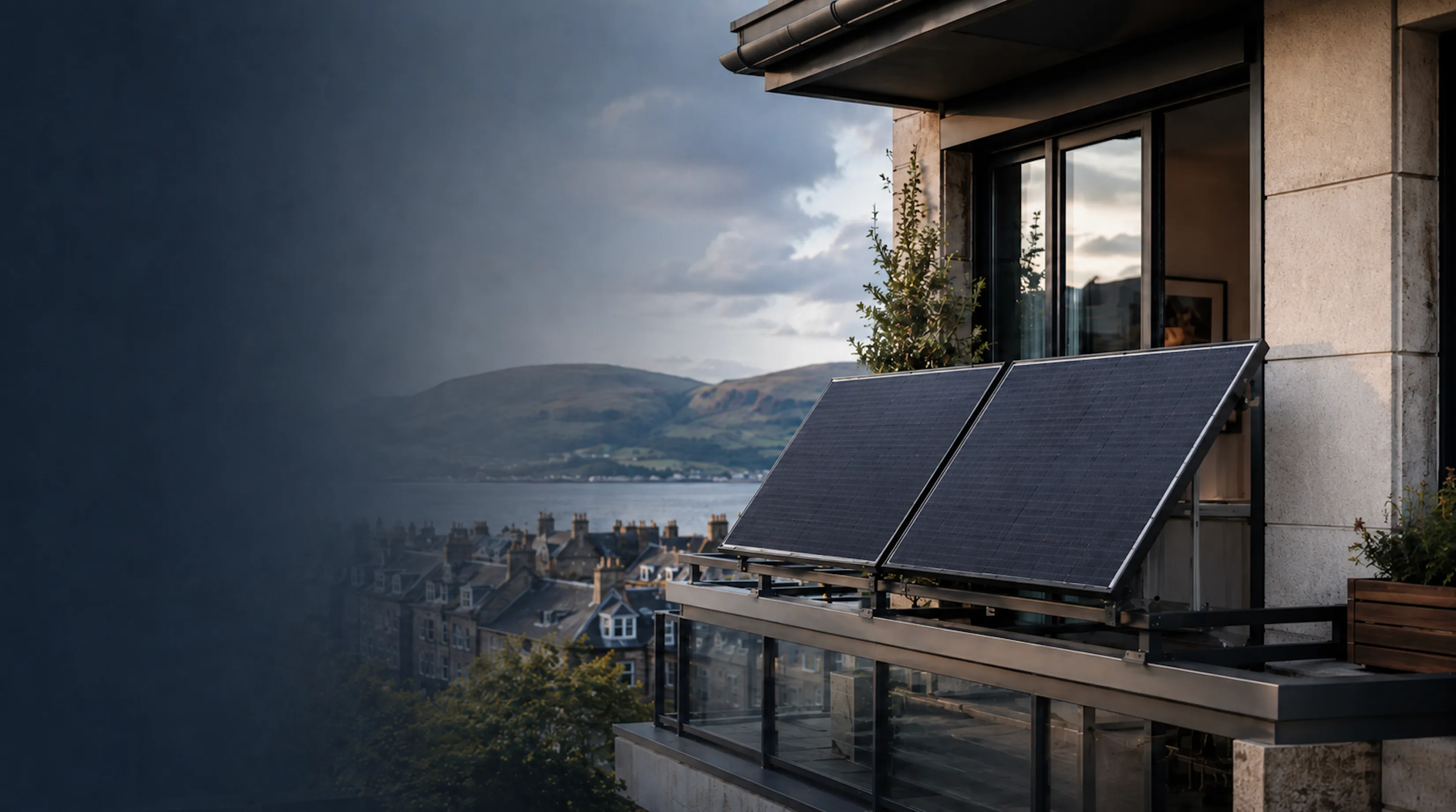
See our wired solar installation serviceThat's why people are interested. Put the panels on a stand in the garden or, if you're allowed, fix them to a balcony rail. No scaffold and no roof job.
But say they're making 600 watts at lunchtime. If the washing machine is on, great, it uses it. If nobody's home and there's only a fridge ticking over, most of it leaves the house. The kit doesn't save the same amount for everyone and this is usually the bit missing from the sales page.
The Two Laws in the Way
The basic problem is that a UK plug was never written to work backwards.
The 1994 plug regulations require BS 1363. Under that standard a plug can't be used to connect generating equipment to a socket. A plug normally takes power out, this kit sends some back in, so it falls at the first hurdle.
There is another set of rules behind it. The Electricity Safety, Quality and Continuity Regulations 2002 work with BS 7671, our wiring regs, and expect solar generation to be a fixed installation wired at the consumer unit. Plug-in solar doesn't fit that either. Both parts need changed before the kit can comply.
You may have seen posts saying BS 7671 "Amendment 4" had already done the job. It hadn't. The March changes to BS 7671 and G98 cleared some of the path, but they didn't remove the blocks in the 1994 plug rules or the 2002 electricity safety rules. Those still count until the replacement regulations are in force.
We've seen 800W quoted as though it were already the legal UK limit as well, usually next to a line about the kits now being "portable appliances". Neither claim appears in the rules that apply today.
So What Did the Government Decide?
Quite a lot, just not the bit that lets you plug one in tomorrow.
DESNZ asked for views in June and got 466 replies. The response came out on 16 July. There was solid backing for it: 88% supported allowing the plug route through BS 1363 and 85% agreed with the interim product specification. The government has taken that as a yes and is carrying on with the changes. Amazon, B&Q, Currys and Lidl had already backed the wider plan, so the shops are hardly being caught by surprise.
The next bit is the legal paperwork. One Statutory Instrument will amend the 1994 plug regulations and the 2002 electricity safety regulations. The final product specification should appear with it; the plain-English guidance is meant to be ready when the new rules start.
Not every solar panel with a three-pin plug will suddenly be fair game. The whole kit will have to meet the new specification, carry a declaration of compliance and appear on the ENA G98 Type Test Register. Batteries have been left out altogether.
When does that start? We don't know. DESNZ said the Statutory Instrument would be put before Parliament "very shortly", which is still not a date. Until it comes into force, the answer at the top of this page stays the same: not legal yet.
Safe? The Kit's Only Half the Story
DESNZ paid for a separate safety study before making the decision. It didn't find anything inherently unsafe about a properly designed kit on normal UK domestic wiring, used the way it was meant to be used. "Properly designed" is doing a fair bit of work in that sentence. A cheap panel and a plug aren't enough.
The government has also chosen one compliant device per power circuit, once G98 is changed to match. G98 currently allows one per household. In practice that distinction can wait, since none of the kits can lawfully be used yet.
The house wiring matters just as much as the box. Plenty of older Scottish properties have been altered a room at a time over the years. Tenements around Stirling, Dunblane and Bridge of Allan can have mixed circuits, older protection and very little paperwork showing what went where. A new-looking consumer unit doesn't tell you the history of the socket you plan to use.
We'd want to know that the circuit and RCD protection were right before anything started feeding power back through them. That needn't turn into a drama. Ask us during a solar survey and we'll have a look.
Flats and Tenement Balconies: Not So Fast
The electrical rules are only one permission. In a flat or tenement, the wall, balcony or roof may not be yours to alter in the first place. The government response hasn't tidied up planning, building regulations or tenancy rights; it tells people to check the local position and get whatever consent is needed.
For a house, an ordinary wired rooftop system will mostly sit under permitted development now that Scotland has relaxed the rules. Flats are different. Work to a flatted property will usually need planning permission. A top-floor owner may get roof panels agreed; for someone two floors down, it isn't much of an option.
Balconies get awkward quickly. Adding a balcony, roof terrace or raised platform isn't permitted development, and anything projecting by roughly a metre will generally need permission. Listed buildings and conservation areas narrow it again. Panels can't stick out by more than about a metre, and a road-facing front or side in a conservation area is likely to be a non-starter. That catches a fair number of town-centre tenements in Stirling, Dunblane and Bridge of Allan.
Then there are the common parts. Fix something to those and the factor or owners' association gets a say. Anyone in a tenement will know how long that conversation can become.
Our guide to solar on flats and tenements in Scotland has the planning side in more detail.
What It Costs, and What It'd Really Save Up Here
The industry figure is £115 to £227 a year for a well-positioned 800W kit. For Scotland, we'd work from the lower end of that range. They aren't figures from our own monitored installations and we wouldn't present the top end as a normal result up here.
Most of the kits being discussed are around 800W: two panels of roughly 400W and an 800W microinverter. Prices run from about £440 to £1,120, although a lot of the entry-level offers sit between £400 and £800. Expected annual output is somewhere around 600 to 900 kWh. One set of modelled figures gives London 793 kWh and Manchester 696 kWh. Scotland will usually be around the Manchester figure or below it, especially with a shaded or north-facing balcony.
Where the sales pitch tends to go quiet is export. The useful electricity is the bit you use while the panels are making it. If the house is empty at two in the afternoon, most of that generation heads out to the grid and these small kits aren't set up to earn export payments in the way a proper certified system can.
That makes your routine important. South-facing and somebody home during the day is a decent fit. An empty house and a shaded balcony is a very different calculation. Put your own address into the solar cost calculator before trusting the number on a box.
Plug-in Kit or a Proper Install
They both make electricity from sunlight, but that's about where the useful comparison ends. The plug-in kit is the smaller, cheaper option for someone who rents or can't use a roof. A full installation costs more and involves proper design and electrical work, but it also produces enough to make a meaningful difference to the bill.
Plug-in kit
£400–£800
System size: ~800W
The lighter option for a flat or rented place once the rules allow it. It is not legal to use yet.
- Usually a few hundred kWh a year
- No MCS certification
- No Smart Export Guarantee payments
- Designed to be self-installed
- Most value comes from using the power straight away
Full MCS roof install
Multi-kW
System size: 4kW and up
A bigger job for homeowners, with much more output and a certified installation.
- Thousands of kWh a year
- MCS certified
- Eligible for Smart Export Guarantee payments
- 0% VAT until 31 March 2027
- Pairs with battery storage
If you own the place and have a usable roof, the wired route will usually make more sense over the years you live there. Battery storage can keep more of the afternoon generation in the house for later. Our Scotland solar installation guide shows what the installation actually involves.
Our Advice for Now
We wouldn't buy a plug-in kit yet. Not because the idea is bad, but because a seller calling one "legal now" is getting ahead of the law. You could be left with a box you can't switch on, and there's no guarantee that a kit sold early will meet the final specification.
If you own a suitable roof and want solar now, get it surveyed. The wired system is legal, certified, eligible for export payments and still carries 0% VAT. We'll tell you if the roof or the numbers don't work.
For a flat or tenement, check the permissions before the product. Landlord, factor, planning and then the wiring. Better to find the problem there than after you've paid for the panels.
Plug-in Solar in Scotland: FAQs
The questions we're being asked about plug-in and balcony solar.
Sources:
- GOV.UK, Plug-in solar: government response (DESNZ, 16 July 2026)
- GOV.UK, Plug-in solar consultation outcome
- Solar Power Portal, DESNZ opens consultations on plug-in solar (17 June 2026)
- Solar Energy UK, Planning permission removed for Scottish rooftop solar
- mygov.scot, Attach something to or alter the outside of your flat
Thinking About Solar in Central Scotland?
We're MCS-certified installers covering Stirling, Falkirk, Perth, Dunblane, Bridge of Allan and across Central Scotland. We'll give you a straight answer on whether plug-in solar is worth waiting for, or whether a proper roof install suits you better. No pushy sales.
MCS-certified solar installers serving Stirling, Falkirk, Perth, Dunblane, Bridge of Allan, and Central Scotland. This article reflects the regulatory position as of 18 July 2026 and will be updated as the rules change.
Related Articles
Continue reading with these similar topics
Backup Power with Home Batteries in Scotland: Simple, Safe, and Actually Useful When the Lights Go Out
Straight-talking guide to home battery backup in Scotland: critical circuits vs whole-home, EPS island mode, PME earthing, G98/G99 compliance, BS 7671 safety, and what really works when power cuts hit.
Do You Need a Fuse Box Upgrade for Your EV Charger?
A straight answer for Scottish homeowners on when an EV charger install needs a consumer unit upgrade, what BS 7671 Section 722 requires, and what it really costs.
Scotland's New Build Solar Regulations: What Section 6 Actually Requires (And What It Doesn't)
Scotland's Section 6 Building Standards don't require solar on new builds — but the financial case says you should install it anyway. System sizing, savings estimates, and practical guidance for developers and self-builders.