

Scotland's New Build Solar Regulations: What Section 6 Actually Requires (And What It Doesn't)
Scotland's Section 6 Building Standards don't require solar on new builds — but the financial case says you should install it anyway. System sizing, savings estimates, and practical guidance for developers and self-builders.
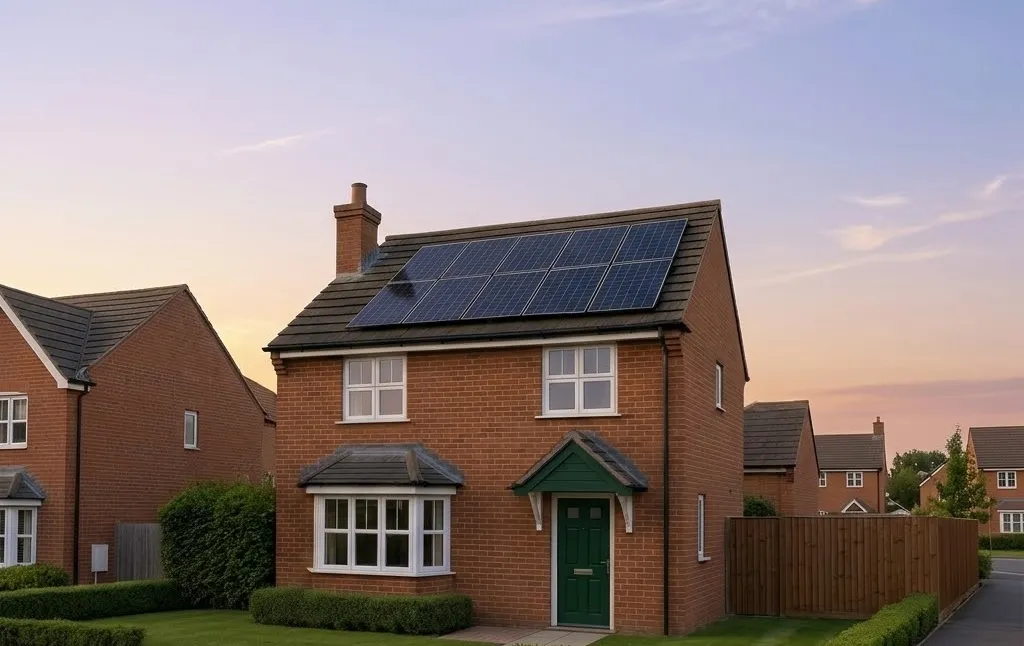
Scotland's New Build Solar Regulations: What Section 6 Actually Requires
The Quick Version
How Solar Stopped Being Part of the Compliance Calculation
Scotland was ahead on this for years. The 2015 Section 6 energy standards tightened dwelling emission rates enough that PV was routinely specified on gas-heated new builds to meet compliance. England's 2021 Part L uplift had a similar effect later.
Then the New Build Heat Standard landed in April 2024 and removed direct-emissions heating from the default new-build pathway. The old Section 6 had two calculation routes: one for gas-heated homes (which commonly needed PV to pass) and one for heat pump homes (which didn't). When gas and oil boilers were taken off the table, every new build defaulted to the heat pump pathway. Solar was no longer needed to pass the calculation.
The result is that solar simply isn't part of Scotland's current compliance requirement — not because it was deliberately excluded, but because the heat pump pathway never included it.
What the Regulations Actually Require Right Now
From April 2024
- Zero direct emissions heating in all new dwellings — typically an air-source heat pump, though electric heating and heat networks are permitted
- No gas or oil boilers
- Solar panels are not required — the developer decides whether to include them
From 31 March 2028
- Scotland is moving toward a Passivhaus-equivalent standard for new homes (Section 6 Stage 2), with detailed energy and ventilation requirements still being finalised
- The direction is fabric-first: improved insulation, airtightness, and MVHR ventilation
- Whether solar and battery storage will be included is still a policy question — the Stage 2 consultation will decide this
England vs Scotland: The Regulatory Gap
Mandatory for:
- England (Future Homes Standard, 2027): Solar panels expected to be compulsory on most new homes
- Scotland (Passivhaus-equivalent standard, 2028): No solar requirement — fabric-first approach, detailed requirements still being finalised
- Both: Gas and oil boilers banned in new builds
Recommended for:
Scotland's Stage 2 consultation is expected to address whether on-site generation will be included — this is still an open policy question
Note: Solar Energy Scotland and other industry bodies are lobbying hard for solar to be included in the final Scottish standard.
Why the Maths Still Says Install Solar at Build Stage
Even without a legal mandate, the financial case for including solar at new build stage is strong — and the technical installation is significantly simpler than retrofitting.
System Sizing for a Typical Scottish New Build
A standard 3–4 bedroom new build with a heat pump typically draws 4,000–5,000 kWh/year in electricity. A 4kW solar array covers a meaningful portion of that:
- Panels: 10 × 400W monocrystalline (JA Solar DeepBlue 4.0 or equivalent) — standard dimension 1,722 × 1,134mm, roughly 20m² of usable roof
- Inverter: Single-phase hybrid inverter rated 3.6kW–5kW (Growatt MIN 5000TL-XH, Fox ESS H3, or SolarEdge with StorEdge interface). A hybrid inverter at build stage means you can add battery storage later without rewiring the AC side
- DNO notification: A system up to 3.68kW export (single-phase) typically falls under G98 — your MCS-certified installer handles the notification to your DNO (SP Energy Networks across most of Central Scotland). Above 3.68kW export generally requires a G99 application, which can take up to 11 weeks. At build stage, this lead time is easily absorbed into the construction programme. Exact export limits and application routes vary by DNO and installer
- Consumer unit integration: New build means a new consumer unit from day one. The solar supply typically gets its own dedicated circuit from the inverter — the exact MCB rating and type is determined by the system design. No retrofitting into an existing board, no capacity concerns
The Cost Advantage of Build-Stage Installation
Adding solar during construction avoids several retrofit costs entirely:
- No scaffolding hire (the roof isn't finished yet)
- Rail and bracket fixings go directly onto battens before tiles are laid — no drilling through weathered tiles or searching for rafters
- Cable routes from roof to inverter location are planned into the first-fix electrical design
- The electrician doing first-fix wiring runs the DC cable and AC isolator positions as part of the standard scope
For self-builders, this typically saves £800–£1,200 compared to a post-completion retrofit of the same system.
Annual Savings
A 4kW system on an energy-efficient new build in Scotland generates roughly 3,400–3,800 kWh/year (based on MCS PVGIS data for Central Scotland at 35° pitch, south-facing). With a heat pump increasing baseload electricity demand, self-consumption rates of 40–50% are realistic without a battery, rising to 70–85% with a 5–10kWh battery.
Estimated annual savings: around £974–£1,151 — though this varies by occupancy, tariff, orientation, and battery setup. The figure is higher than a typical existing home because new builds consume more electricity overall (heat pump, MVHR, induction hob).
What Self-Builders Need to Tell Their Architect
If you're building your own home in Scotland, solar won't appear in the standard Section 6 compliance calculation unless your architect specifies it. You need to explicitly request:
- Roof orientation and pitch optimisation — south-facing at 30–40° is ideal; east/west splits work if the ridge runs north–south, but you'll need a dual-MPPT inverter or optimisers to handle two orientations
- Structural loading — modern panels weigh around 20kg each. Ten panels add roughly 200kg to the roof structure. Your structural engineer needs this in the design, not as an afterthought
- Cable containment — DC cable routes from roof to plant room/utility should be included in the architectural drawings at Stage 3 (developed design). Running DC cables through a finished, airtight Passivhaus envelope after completion is a nightmare
- Inverter and battery location — hybrid inverters generate some heat and noise (fan cooling). Plan a garage, utility room, or plant room location with adequate ventilation, not a bedroom wall
- Metering position — the generation meter and export meter (for SEG payments) sit next to the consumer unit. Make sure there's physical space on the board
The 0% VAT Window
Solar panel installation is zero-rated for VAT until 31 March 2027. After that, installations revert to 5% VAT (reduced rate) under current HMRC rules. On a £6,000–£8,000 system, that's a saving of £300–£400 by acting before the deadline.
For new builds completing in 2026 or early 2027, this is a straightforward win — the solar install happens during construction and invoicing falls within the VAT relief window.
What Happens Next
The Scottish Government's Stage 2 consultation on the Passivhaus-equivalent standard is expected to open soon. This is when we'll find out whether solar panels and battery storage will be written into Scotland's new build future.
Solar Energy Scotland, backed by the wider industry, is pushing hard. England is expected to require solar on most new homes from 2027, and the EU's recast Energy Performance of Buildings Directive is moving toward phased rooftop solar requirements for new buildings — though the exact timelines and scope for residential are still being finalised. The argument that Scotland — which pioneered PV on new builds a decade ago — should be left behind is a difficult one to make.
In the meantime, every new build we wire gets a hybrid inverter and the DC infrastructure for solar, whether panels go on now or later. It's an extra few hundred pounds at first-fix and it saves thousands if regulations change.
Frequently Asked Questions
Common questions about solar panel requirements on Scottish new builds.
Planning a New Build in Central Scotland?
We wire new builds from first-fix to final certification — and we install solar, battery storage, and EV charging as part of the same programme. No middlemen, no return visits.
MCS-certified solar installers serving Stirling, Falkirk, Dunblane, Bridge of Allan, Bearsden, and Central Scotland.
Related Articles
Continue reading with these similar topics
Solar Panels Not Generating? What to Check Before You Assume Something Has Failed
Solar panels showing zero generation? Check the app, inverter, power supply, shading and warning signs before assuming equipment has failed.
Home Battery Storage Scotland 2026: Costs, ECO4 Grants & 0% VAT
Home battery storage in Scotland for 2026: realistic costs (£4k-£10k+), ECO4 grant eligibility before it ends 31 December 2026, 0% VAT until March 2027, and why Home Energy Scotland no longer funds batteries.
Is Plug-in Solar Legal in Scotland? The 2026 Answer
Plug-in and balcony solar became legal to sell and use in Great Britain on 27 August 2026. What that means in Scotland: which kits comply, what they'd really save up here, and the permissions to check first.