

Ground-mounted solar panels in Scotland: planning, cable runs and when they beat the roof
When a ground-mounted solar array makes more sense than the roof, what Scottish planning rules allow in your garden, and how the power gets back to the house.
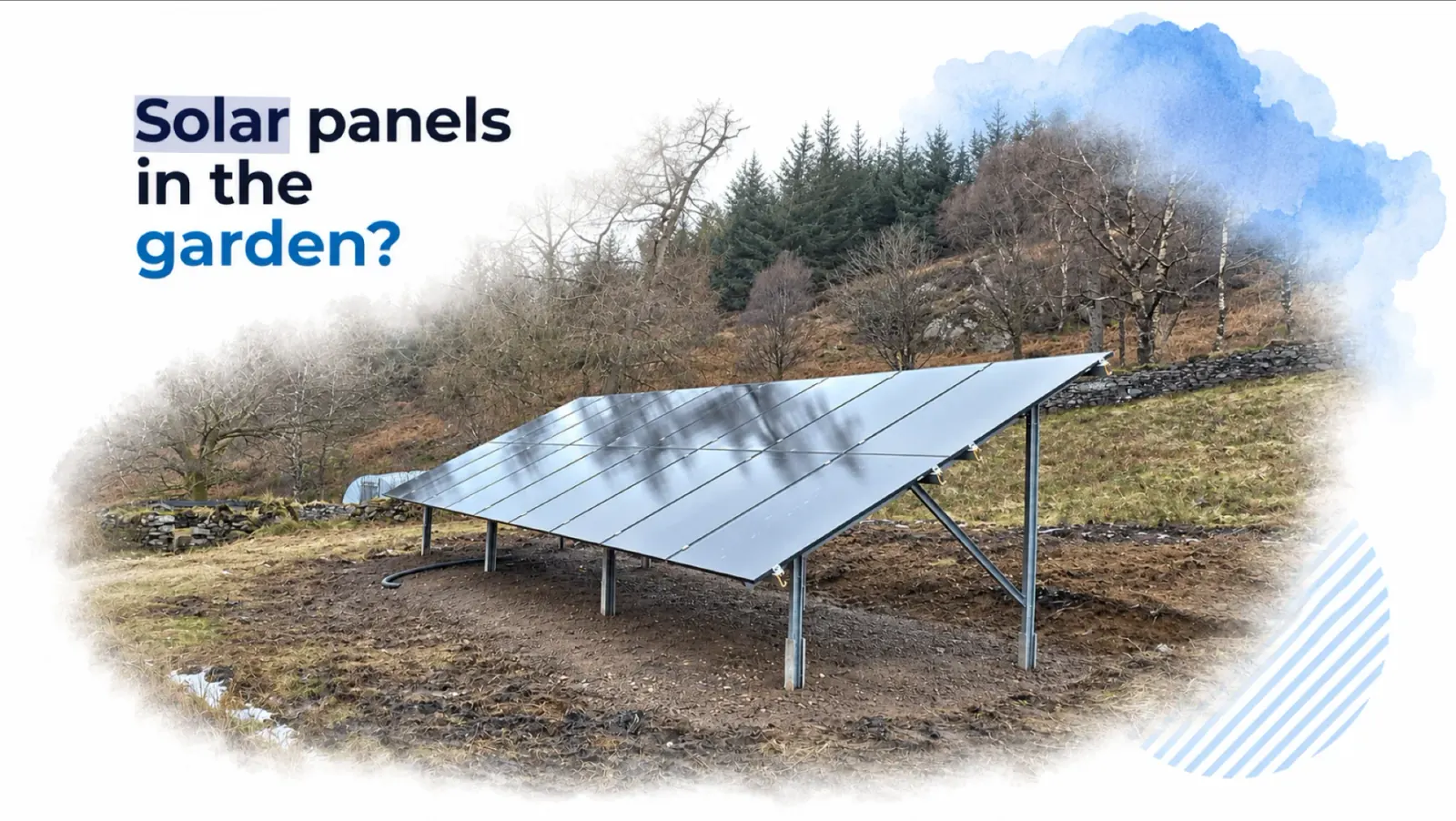
Ground-mounted solar panels sit on a frame in the garden or a field instead of on the roof. In Scotland they can often go in without a planning application, provided the array is within your garden ground, not in front of a wall of the house that faces a road, no more than 3 metres high and outside a conservation area. A field beyond the garden, a listed property or a National Park location needs a closer look before anything is ordered.
Most of the time we'd still start with the roof. If it faces the right way, isn't shaded and is in good condition, a roof array is usually the simpler job. A ground array comes into its own when the roof is the problem and there's open ground with good light nearby. Below are three of the ground arrays we've built, at Kinlochard, Blair Drummond and Dunning, picked because each one came about for a different reason.
The quick answer
When a ground array makes more sense than the roof
A lot of rural houses around Loch Lomond and The Trossachs have the wrong roof for solar: the best roof faces north or east, a hill or a line of trees puts it in shadow for much of the day, the slates are old enough that nobody wants them disturbed, or there are dormers and valleys breaking up the space. Any of those can make a roof array small, poorly placed or more trouble than it's worth.
On the ground we choose the direction and the angle, so the panels face the best light on the site rather than whichever way the roof was built. The Energy Saving Trust's solar guidance explains why orientation and shading matter so much to generation, and those are the two things a ground array lets us control.
There are practical gains too. Nothing gets drilled through the roof, so a future re-roof or repair doesn't mean taking the panels off and putting them back. The panels sit at a height where they can be checked and cleaned without a ladder. And because the work happens at ground level, you don't need scaffolding around the house for the array itself.
The trade-off is that a ground array is a groundworks job as well as an electrical one. It needs footings or foundations, a frame, a trench and a cable run back to the house. It also takes up garden space. Panels in a sunny corner of the garden won't suit everyone, and where the house roof works well, it's usually the better use of your money.
A few of our ground arrays and why we chose them
Kinlochard: a hillside field in the National Park
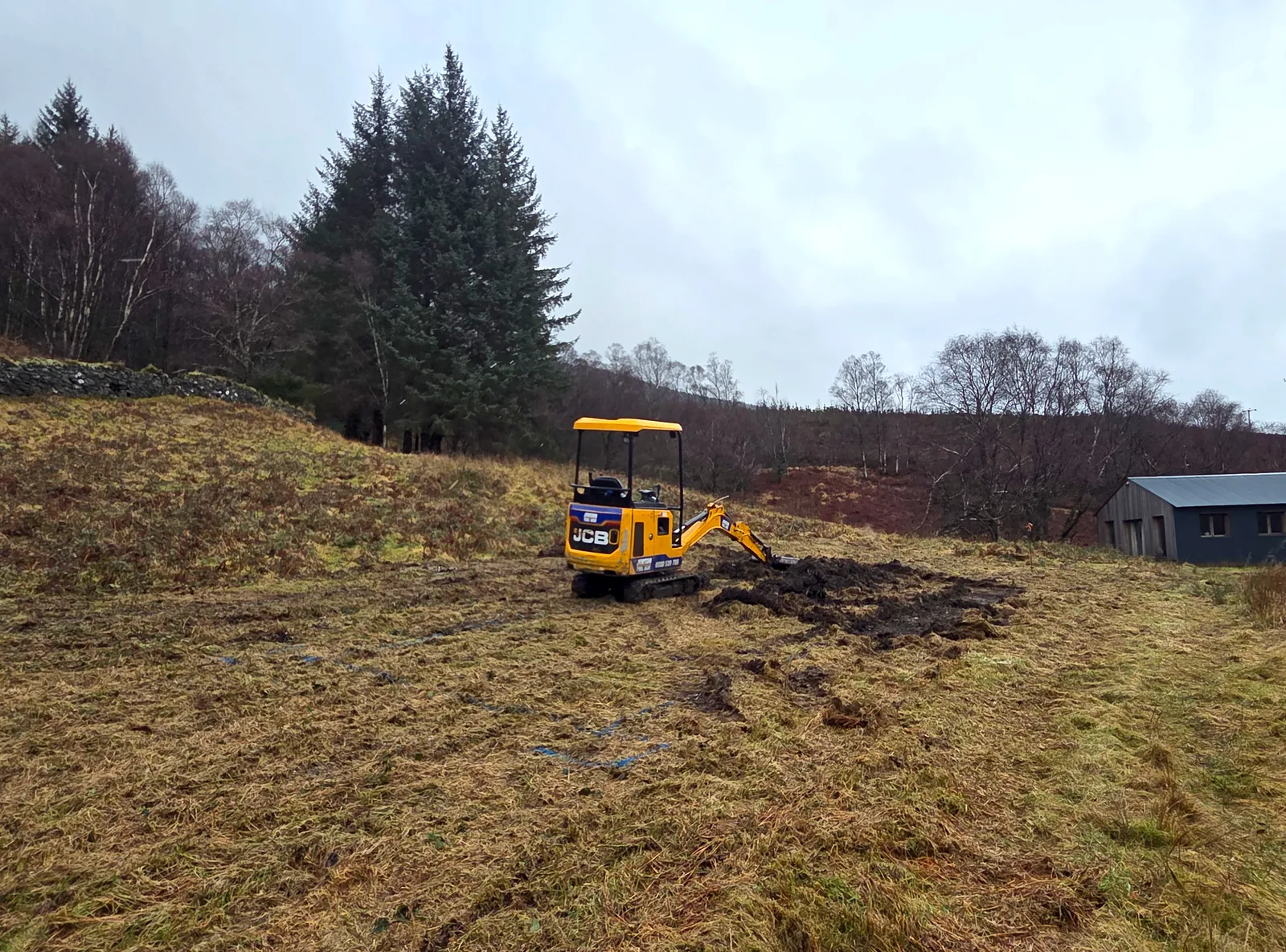
Kinlochard is where we're based. This job put an 8.1 kWp array of 18 × 450W JA Solar panels on a Solarport ground-mount frame in a hillside field. Our team did the groundworks and cable trenching. The site was levelled, foundations set, and the cable run back to the building.
The array feeds a Sigenergy SigenStor 10kW hybrid inverter with 8.76 kWh of battery storage. The battery and isolators are housed in a stone outbuilding. The property's existing hydro generation is tied into the same inverter, and a Sigenergy HomeMax backup gateway keeps the house supplied during a power cut. The design estimated about 6,556 kWh a year from the solar alone, before the hydro.
It's inside Loch Lomond & The Trossachs National Park, and on a site like that we check the planning position with the Park Authority before any equipment is ordered. The full write-up is on the Kinlochard case study.
Blair Drummond: an array that doubles as a garden store
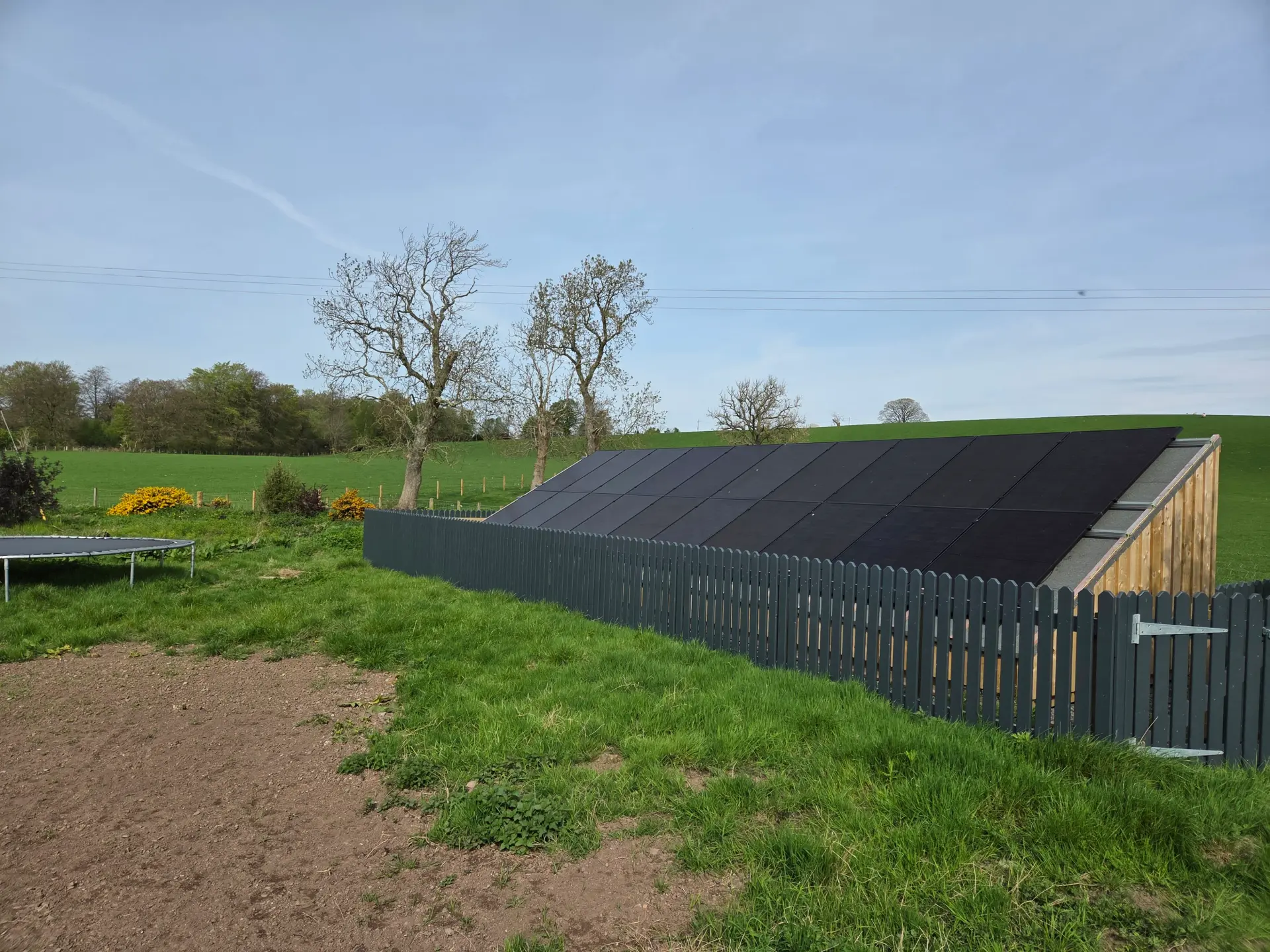
This was a new build on the outskirts of Stirling, where we did the full electrical design and installation along with the solar and battery. The aim was to offset the running costs of a new air source heat pump.
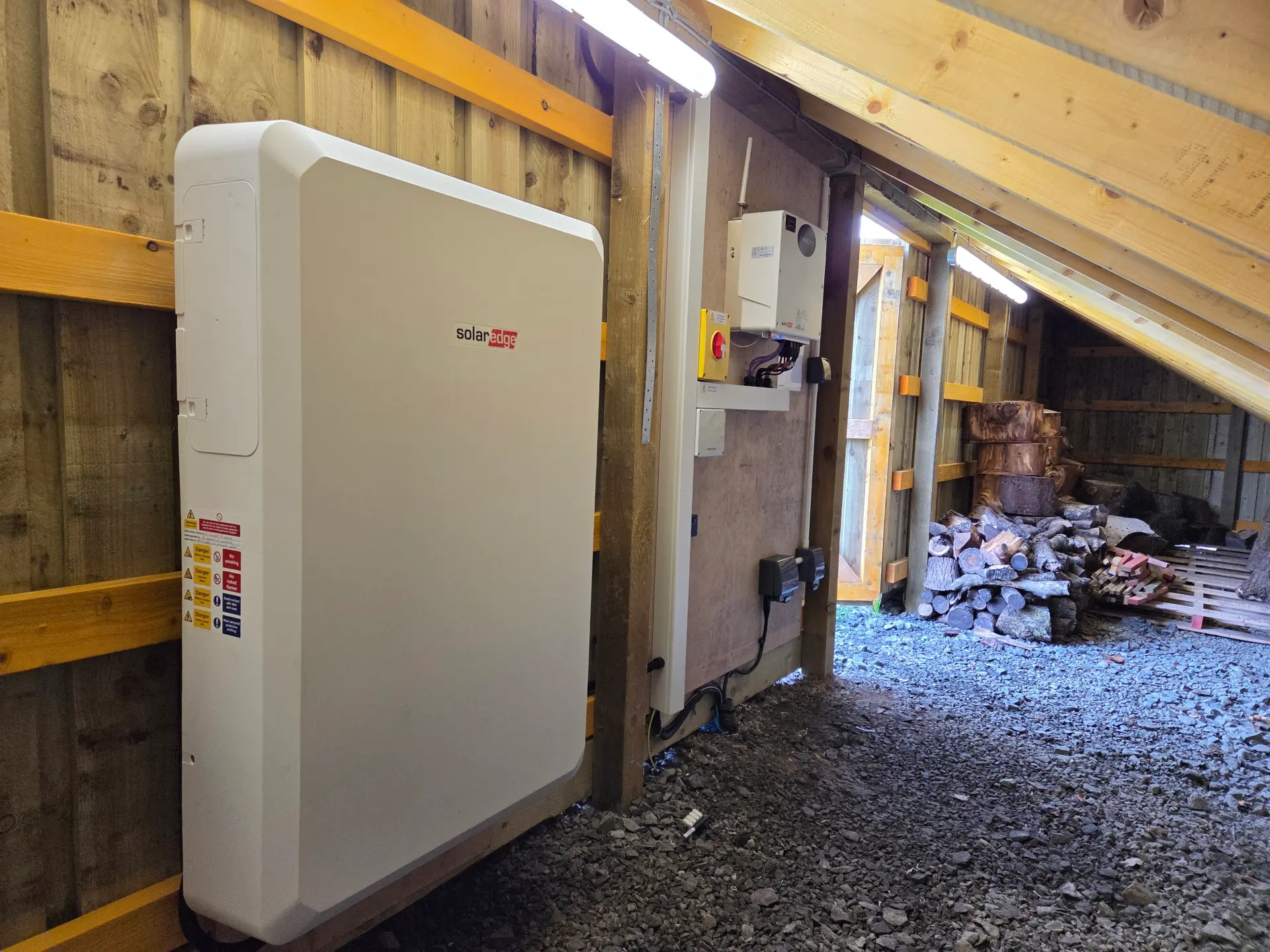
We designed 20 × JA Solar 440W panels on a timber structure that's also a garden store and log store. The structure houses the SolarEdge 8kW inverter and 10kW of battery storage, which keeps that equipment out of the house. A solar iBoost diverts surplus generation to the hot water cylinder, and a 7kW Zappi charger puts surplus into the car.
The MCS-standard estimate for this system was 7,260 kWh of generation a year, a first-year saving of £2,692 and an 8-year payback. Those figures are that job's estimate, based on that household and system. Yours would be calculated from your own usage and site.
Dunning: a flower bed instead of a garage roof
The Dunning customers already had a quote for panels on their garage. When we looked at it, the garage was badly positioned, had a poor pitch and orientation, and raised structural concerns. The house roof had dormers. They asked whether a raised flower bed on top of an old stone wall could work, and after surveying it, we said yes.
That one took real preparation. We dug out the bed, rebuilt part of the wall and formed a concrete retainer on the wall head as a solid base, then built a pressure-treated timber frame for 500W panels and finished the back and sides with fencing slats. A Tesla Powerwall 3 and backup gateway completed the system. Our garage-roof solar guide covers how that decision was made.
Planning permission for ground-mounted solar in Scotland
Scotland's householder permitted development rules are different from England's, so don't rely on an English guide's size or boundary limits for a Scottish garden.
In Scotland, free-standing solar panels within the curtilage of a house fall under Class 3B of the General Permitted Development Order. The Scottish Government's Circular 1/2024 lists free-standing solar panels among the works this class is intended to cover. The 2024 changes to rooftop solar, in force from 24 May 2024, rewrote the classes for panels on houses and other buildings; they didn't change the limits for free-standing panels, and the Scottish Government's 2023 consultation said it wasn't minded to amend Class 3B.
Under Class 3B, an array is permitted development only if:
- no part of it is forward of the front wall or a side wall of the house, where that wall faces a road
- it's no more than 3 metres high, measured on sloping ground from the lowest point next to it
- it doesn't take the developed area to more than half of the rear (or front) garden, counting existing extensions, sheds and garages but not the original house, hard surfaces or decking
- the property isn't in a conservation area and the array isn't within the curtilage of a listed building
The 3-metre limit is rarely a problem for a domestic frame on level ground, but on a slope the low side counts, so it's worth measuring on a hillside garden.
Fields, paddocks and land outside the garden
Class 3B covers land within the curtilage of the house, which in practice means the garden ground that goes with it. A field, paddock or bit of land beyond that isn't covered, even if you own it. That's often where the best spot for a larger array is on a rural property, so expect to ask the planning authority what's needed before going further.
National Parks, Article 4 directions and earlier conditions
The Class 3B wording doesn't list National Parks as an exclusion, but the circular warns that permitted development rights can be restricted in places such as National Parks, National Scenic Areas and World Heritage Sites. Inside Loch Lomond & The Trossachs National Park, the Park Authority is the planning authority and handles householder enquiries.
Two other things can remove permitted development rights on a particular property. A council can make an Article 4 direction for an area, and an earlier planning permission for the house may carry a condition restricting further work. Your planning authority can tell you whether either applies.
If you want certainty in writing before committing to the work, you can apply to the planning authority for a certificate of lawfulness of proposed use or development.
Dual-use structures
A frame holding panels is assessed differently from a structure like the Blair Drummond store, which is a building in its own right. Outbuildings have their own permitted development class, and panels on an outbuilding have another. If you'd like the array to double as a store, carport or shelter, check how the whole structure will be treated before it's designed.
Building warrants and building standards
Planning and building standards are separate in Scotland. The circular notes that a building warrant may be required for the kind of works Class 3B covers, and the domestic technical handbook doesn't have a specific exemption for a free-standing solar array. Work that doesn't need a warrant must still meet the building regulations.
So we treat this as a question for the council's building standards service for the specific design, particularly where the frame becomes a structure you can walk into. The electrical installation itself is designed, tested and certified to BS 7671.
Getting the power back to the house
Folk picture the panels and forget the cable. But every ground array needs a run back to the house, and that run goes under your garden. Under BS 7671 it has to be armoured cable with the armour earthed, or a cable with a metal sheath, or it goes in a proper duct, and it sits deep enough that someone digging a border or putting in a fence post won't hit it. Then cable tiles or warning tape go in above it so the next person with a spade knows it's there. How deep exactly? There's no one number. The IET's guidance on buried cables says it comes down to what the ground gets used for, so a lawn is one thing and a veg patch or a field that gets ploughed is another.
The longer the run, the thicker the cable can get, because we've got to keep the voltage drop down, and thicker copper costs more. Where the inverter lives changes things as well. At Blair Drummond it's in the store right beside the array. At Kinlochard the battery and isolators went in an outbuilding.
We walk the route at the survey. Paths, the driveway, drains, any other pipes or cables in the ground, tree roots, the bit of lawn you'd really rather we left alone. Your quote should show where the trench goes and what we put back afterwards.
Network connection: G98 or G99
You can't just connect solar to the grid and say nothing, your network operator has to know. Across most of Central Scotland that's SP Energy Networks, further north it's SSEN. Up to 16A per phase, so 3.68kW on a normal single-phase house, it's G98. We fit it, commission it and send the installation document to the network operator within 28 days. Go over that and it's G99, which means applying first and waiting for approval before anything's switched on. And anything already generating on the property counts towards the total. Kinlochard has a hydro, so that went into the sums, and with a second generator going on the network operator will usually want an application in before it's connected.
Where the local network is constrained, the network operator may approve a larger system with its export limited under G100. We handle the notification or application as part of the job.
Batteries, EV charging and backup from a ground array
The array connects into the home's electrics like any other solar system, so a battery, a hot water diverter or an EV charger can be added in the same way. Blair Drummond has all three. Kinlochard and Dunning were built with backup in mind, and both have a backup gateway, which is the part that keeps the house running in a power cut rather than the battery on its own. Our emergency backup power page explains how that part works.
Housing the battery and inverter in a store or outbuilding by the array is an option we've used, but the location still needs to meet the manufacturer's requirements and be reachable for maintenance.
What affects the cost
We don't publish a standard price for ground-mounted solar because the variables are bigger than for a roof job. The panels, inverter and any battery are much the same either way. The difference comes from the frame and its footings, the groundworks to level and prepare the site, the length and route of the trench, the cable size that distance requires, and the reinstatement afterwards. A structure that also serves as a store or shelter adds joinery. On the other side, you're not paying for scaffolding on the house.
On some sites a ground array can work out cheaper than a roof alternative, especially where the roof would need work first. On others it's the more expensive option. The way to find out is to compare a measured roof proposal and a measured ground proposal for the same property.
VAT, export payments and funding
Qualifying solar installations in homes currently have 0% VAT, until 31 March 2027. From 1 April 2027 the reduced rate of 5% is due to apply. HMRC's VAT Notice 708/6 defines solar panels as systems installed "in, or on the site of, a building", and the relief applies to installations in residential accommodation, so a ground array at your home can qualify when the other conditions are met. The zero rate applies to installation; panels bought without installation are standard-rated. Get the VAT treatment confirmed on your quote.
To sell exported electricity under the Smart Export Guarantee, you need to show that both the installation and the installer are certified through MCS or an equivalent scheme, and have a meter capable of half-hourly export readings. Suppliers set their own tariffs. We're MCS certified, and the certificate is issued for the installation when it's commissioned.
The Home Energy Scotland Grant and Loan page doesn't list standard solar PV panels as a funded measure at the moment. Its solar entries are solar thermal and hybrid PV-T systems, offered as loans. Check with Home Energy Scotland before relying on any support.
Planning, VAT and funding information checked 19 November 2026. Rules change, so recheck the linked sources before ordering.
Ground-mounted solar questions
What to send us
If you have open ground and a roof that isn't ideal, start a solar enquiry. Tell us your postcode, roughly where you'd put the array and how far that is from the house, and whether it's within the garden or in a field. Photos of the spot and of the roof, plus a recent electricity bill, give us a good start. Mention if you're in a conservation area, a National Park or a listed property, and if you're also thinking about a battery or EV charger.
We'll look at the roof and the ground options together and tell you which we'd recommend and why. Our solar installation service explains how we plan the work from survey to commissioning.
Find out whether a ground array suits your property
Tell us about the ground, the roof and your electricity use. We'll look at both options, check the planning position and cable route, and explain what the survey needs to confirm before quoting.
Related Articles
Continue reading with these similar topics
The Ultimate Guide to Solar Panel Installation in Scotland 2026
Your complete 2026 guide to solar panels in Scotland. The funding that's actually available, honest installation costs, SEG payments, ROI, and the step-by-step process.
Solar panels on a garage roof in Scotland: is yours suitable?
Could your garage roof suit solar panels? Check roof strength, shade, flat-roof mounting, Scottish planning rules and the connection back to your home.
Are solar panels worth it in Scotland? An honest guide for homeowners
Whether solar panels pay off on a Scottish home comes down to your roof, when you use electricity and what you're paid for export. Here's how we'd weigh it up, with Energy Saving Trust figures and the estimates from our own installs.