

Vehicle-to-Grid: Making Money From Your Car (And Why You Should Probably Wait)
A guide to V2G for Scottish homeowners. What it is, why it's not quite ready, and what you can do right now instead.
Quick Summary
What V2G Actually Is
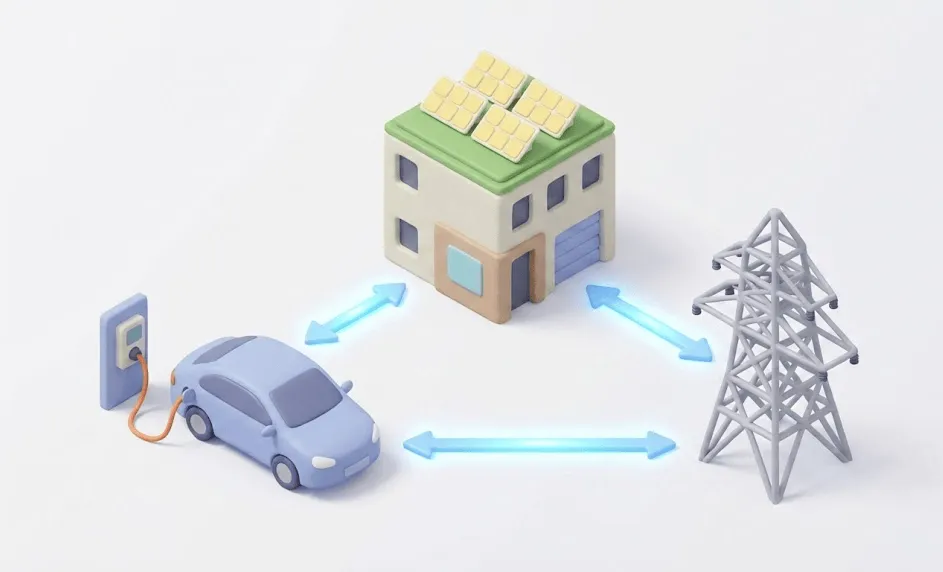
Your EV can sit on the drive for 22+ hours a day. It's usually got a 60 kWh battery sometimes bigger, and it's parked up doing nothing while you're at work, while you're asleep, while you're watching telly. There's enough stored power in that thing to run your house for the best part of three days. Vehicle-to-Grid is where you use that. Overnight, when wind power is cheap and the grid is quiet, your car fills up for pennies. Come teatime when everyone gets home and flicks on the heating and the oven and the TV all at once, wholesale prices spike. Your charger reverses the flow, pushes power back into the grid and you get paid. The car tops back up again at 2am. You set it to say "I need 80% by 7am" and forget about it. It sounds brilliant. It is brilliant. But before you rush out to sign up we need to have a look at the reality of doing this in Scotland right now.
Why Scotland Specifically
In 2025, Scotland curtailed over ten terawatt hours of wind energy because the cables running south were full. That's enough to power every home in Scotland for a year. The turbines were spinning, the wind was howling, and the National Grid control room picked up the phone and told the wind farms to switch off. Everyone with an electricity bill in Britain picked up a £343 million tab for perfectly usable energy that got binned. We all paid for that. Scotland generates about 113% of what it actually consumes. We are not short on renewable energy. The problem is when the wind blows hard at 3am nobody is boiling a kettle. If we had a million EVs plugged in acting as sponges, soaking up that excess and selling it back at 5pm when the gas plants fire up, we wouldn't need half the infrastructure we're currently trying to build. So the logic is sound. But trying to actually get a V2G system installed right now is where it gets painful.
The Only Option Right Now
If you want V2G today you've got one choice which is the Octopus Power Pack. It's a bundle... you lease a BYD Dolphin, you get a Zaptec Pro charger, you get the tariff. The tech is clever, they've stuck the expensive inverter inside the car so the wall charger stays cheap. And it works. But here are problems with it and the biggest one is going to annoy exactly the people who'd be most interested. If you have solar panels on your roof, Octopus now allows this tariff in principle. The problem is the DNO end. The moment you try to get G99 for mixed export (car + solar), the paperwork gets messy and that's where applications die or the grid says no. So if you're the type of person who wants to generate their own power and drive an EV and do the whole thing properly... V2G is often still off the table. You have to choose between cheap driving or free solar. You can't have both. This is frustrating because the energy-savvy homeowners who've already invested in solar are exactly the people who'd want V2G. But that's where we are right now.
G99 and the DNO Problem
This bit will be familiar if you've read our commercial solar guide. The moment you want to push electricity back to the grid you become a "generator" in the eyes of the network. You need a G99 application through your DNO, which is SSEN if you're north and east Scotland or SPEN if you're central belt and south. The application costs money, takes up to 12 weeks (often longer in practice), and they can say no. If the substation on your street is old or the cables are a bit thin then that's it, rejected. You still pay the fee though. For context, this is the same G99 process that commercial solar installations go through. It's not a quick form, it's a proper application and the DNOs take their time with it.
The Charger Situation
Then there's the hardware. Of 14 bidirectional chargers submitted for UK testing last year, 11 failed. The ones that passed use CHAdeMO which is a connector standard that is basically dying. Most new EVs use CCS and finding a CCS bidirectional charger you can actually buy and get installed today is... difficult. They're coming but they're not here yet. So say you don't want the BYD Dolphin. Say you've got a Nissan Leaf, one of the only real players right now. Great. Now go find a compatible charger and an installer who's done one before. VW ID gets talked about, but it's still stuck in V2H trials and beta.
What To Do Instead
Here is the thing. You don't actually need V2G to get 90% of the benefit. While everyone is waiting for the chargers and the DNO paperwork to sort itself out, our smartest customers are doing what we call a Virtual Power Plant. It's working right now, not in 2028. You get a dedicated home battery, a Tesla Powerwall or a Sigenergy system, say. You pair it with a smart charger, a Zappi or an Ohme, and if you've got solar you tie the whole lot together. The battery charges overnight on the cheap smart tariff, seven pence a kilowatt hour give or take. During the day your panels run the house and top up whatever the battery used in the morning. Any excess solar gets dumped into the car through the smart charger. If it's been grey all day, welcome to Scotland, the charger waits until the cheap window at 2am and fills the car then. You're buying power at 7p and dodging the 28p peak rate. Your house runs on stored energy during the teatime spike. You're insulated from price shocks. It's not quite true V2G but the difference is mostly academic for what you're actually saving. And here's what matters... you can have solar. You can drive whatever car you want, you're not locked into a BYD lease. For most standard setups, the paperwork is a simple notification after we're done, not a 12-week begging mission before we start. Big systems can still need full G99, but that's a well-oiled machine installers handle every day, not the V2G special case the grid seems allergic to. If you move house you take the battery with you.
Should You Wait for V2G?
In 2027 or 2028 when the chargers are standardised and the regulations catch up, V2G will probably be worth it. But right now it's for people who enjoy filling out forms and don't mind mixed-export G99 getting buried in DNO paperwork. If you want to save money this year the solar plus battery plus smart charger setup is what actually works. It pays for itself, it's reliable, and you don't need to run the V2G-style pre-approval gauntlet before it goes live.
Need Help With Your Setup?
We can look at your usage, your roof, and your car and tell you what combination makes sense. Whether that's a full solar and battery system or just getting a smart charger on the right tariff, we'll give you the real numbers.
Need Help With Your Setup?
We can look at your usage, your roof, and your car and tell you what combination makes sense. Whether that's a full solar and battery system or just getting a smart charger on the right tariff, we'll give you the real numbers.
Frequently Asked Questions About V2G in Scotland
Common questions from Scottish homeowners about vehicle-to-grid, G99, charger availability, and what to do instead right now.
Related Articles
Continue reading with these similar topics
Octopus Flux vs Go vs Intelligent Go in Scotland: Which One Should You Actually Use?
Flux vs Go vs Intelligent Go in Scotland: which Octopus tariff suits solar, batteries and EVs? See live Southern Scotland rates, examples and installer advice.
Home Battery Storage Scotland 2026: Costs, ECO4 Grants & 0% VAT
Home battery storage in Scotland for 2026: realistic costs (£4k-£10k+), ECO4 grant eligibility before it ends 31 December 2026, 0% VAT until March 2027, and why Home Energy Scotland no longer funds batteries.
No Solar Panels? You Can Still Install Home Battery Storage in Scotland
A guide to standalone home batteries, smart tariffs, and what installers check before fitting one.