

Pigeons under solar panels: bird proofing in Scotland
How to tell if pigeons are nesting under your solar panels, what they damage, when the law lets you proof the array in Scotland, and what a bird mesh visit involves.
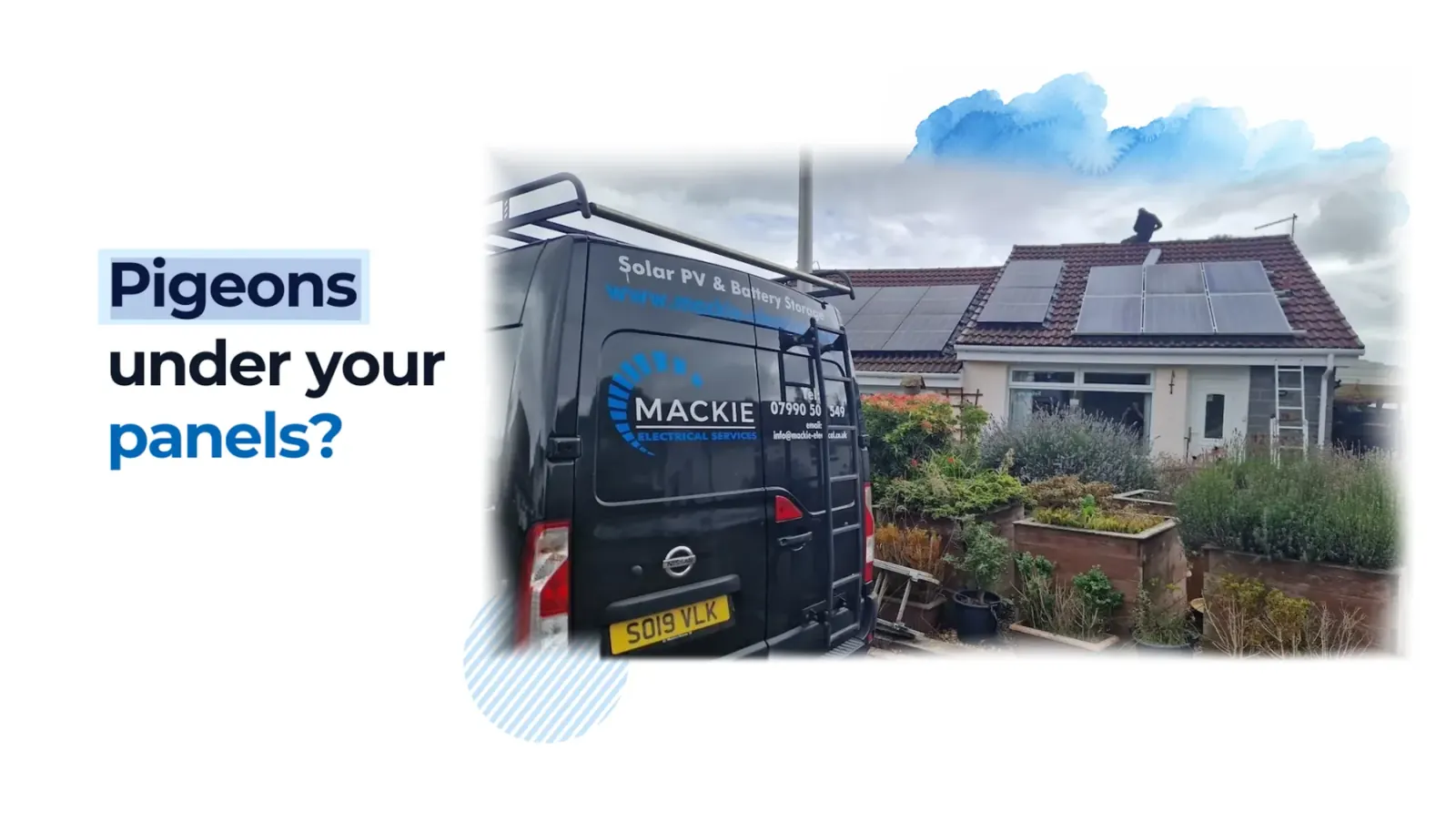
If you can hear cooing and scratching on the roof first thing in the morning, and the gutter under your solar panels is filling with twigs and droppings, pigeons have probably moved in under the array. The gap between the panels and the tiles gives them a sheltered ledge, and once they're nesting there the mess builds up on the glass, in the gutters and around the cabling underneath.
The fix is to clear out what's there, check the system over and fit mesh around the edge of the array so the birds can't get back underneath. In Scotland the timing matters, because the law protects nests that are being built or are in use. We do this as part of our solar PV maintenance and repairs work across Central Scotland, on systems we installed and on systems fitted by other companies.
The quick answer
Signs of pigeons under your solar panels
Most people notice the noise before anything else. Pigeons shuffling and cooing under the array can often be heard from a bedroom or the loft, especially early in the day. Look up from the garden and you may see birds landing on the panels and disappearing under the bottom edge, or twigs and feathers sticking out from the gap.
Droppings are the other giveaway. They streak the glass, collect in the gutter below the array and land on paths, sills and cars underneath. A gutter that keeps overflowing under the panels, when the rest of the roof drains fine, can be packed with nest debris that has washed or been kicked out from behind the array.
Your monitoring can tell you something too, though less reliably. A gradual drop in generation that isn't explained by the season or the weather can come from heavy soiling on the glass. A sudden drop or an inverter warning is a different matter and needs fault finding, which our guide to solar panels not generating explains.
Why pigeons choose the gap under a solar array
Feral pigeons come from rock doves, which nest on cliff ledges, and the RSPB points out that roofs and bridges mimic that natural preference. A pitched solar array adds a roof over the roof. The space underneath is a sheltered ledge, out of the wind and rain, and that's what they look for in a nest site.
They also aren't fussy about the season. Coventry City Council's pigeon information sheet says feral pigeons are capable of breeding all year round, with a peak between March and July, and that their nests are built from whatever they can find: twigs, feathers and scraps of plastic and wire. The same sheet says new eggs can be laid when the young are as little as 20 days old, before they've fledged, so a pair can raise more than one brood in a year.
What pigeons damage on a solar system
The glass gets the obvious damage. JA Solar's installation manual says dirt on the front of the panel reduces power output and can cause a hot spot, and singles out bird droppings as a serious case because they block light in one patch instead of spreading evenly like dust. Rain clears a fair amount of ordinary dirt from a pitched array, but droppings tend to stay put and need cleaned off.
What happens underneath matters more to us as electricians. The DC cables, connectors and, on some systems, optimisers sit in the space under the panels. That's where the nest material, droppings and feathers pile up, out of sight from the ground. AXA's risk guidance for roof-mounted solar lists damage from birds, and build-up of dirt, vegetation or droppings causing hot spots, among the things that can lead to faults. The same guidance cites BRE research from 2017 that found faults in the DC components were the main cause of solar fires, and in most cases DC isolators and connectors were involved.
That's why, on a bird job, we want to see the cabling and connectors we can reach, and check the system is generating as it should, before the mesh goes on and the space is closed off. Blocking the gap is only half of it; the electrical checks need a solar electrician.
Bird nests and the law in Scotland
The Wildlife and Countryside Act 1981 applies to wild birds in Scotland with some Scottish wording of its own. Under the Scottish version of section 1, it's an offence to intentionally or recklessly take, damage, destroy or otherwise interfere with the nest of any wild bird while that nest is in use or being built. It's also an offence to obstruct or prevent any wild bird from using its nest. Fitting mesh around an array with an active nest behind it could do exactly that.
NatureScot issues general licences that allow some action against certain species. Its 2026 licence GL03 covers feral pigeons for preserving public health and public safety and preventing the spread of disease, and runs from 1 January to 31 December 2026. A general licence is not a blanket permission. Anyone relying on one has to meet its stated purpose and conditions, and it only covers the species it lists. Not every bird nesting on a roof is a feral pigeon, so check what's actually under there before anything is removed. If you're unsure, NatureScot's licensing team is the place to ask.
So the practical rule is to proof the array when no nest is active. If birds are sitting on eggs or feeding chicks when you get in touch, we'll talk through the timing with you rather than sealing them in.
Legal and licence information checked 19 November 2026. General licences are reissued each year, so check NatureScot's current licence before relying on it.
When to bird-proof solar panels in Scotland
The RSPB describes March to September as the main nesting season. Feral pigeons can nest outside that window, but autumn and winter are usually the best time for proofing, after the year's broods have left and before the next season starts. We still check for an active nest on the day.
Roof work needs a dry, reasonably calm day, and short daylight in a Scottish December leaves less time on the roof. If you've noticed birds this year, getting the job booked over the winter means the mesh is on before the spring peak in nesting.
Fitting solar panel bird mesh: what we do on a visit
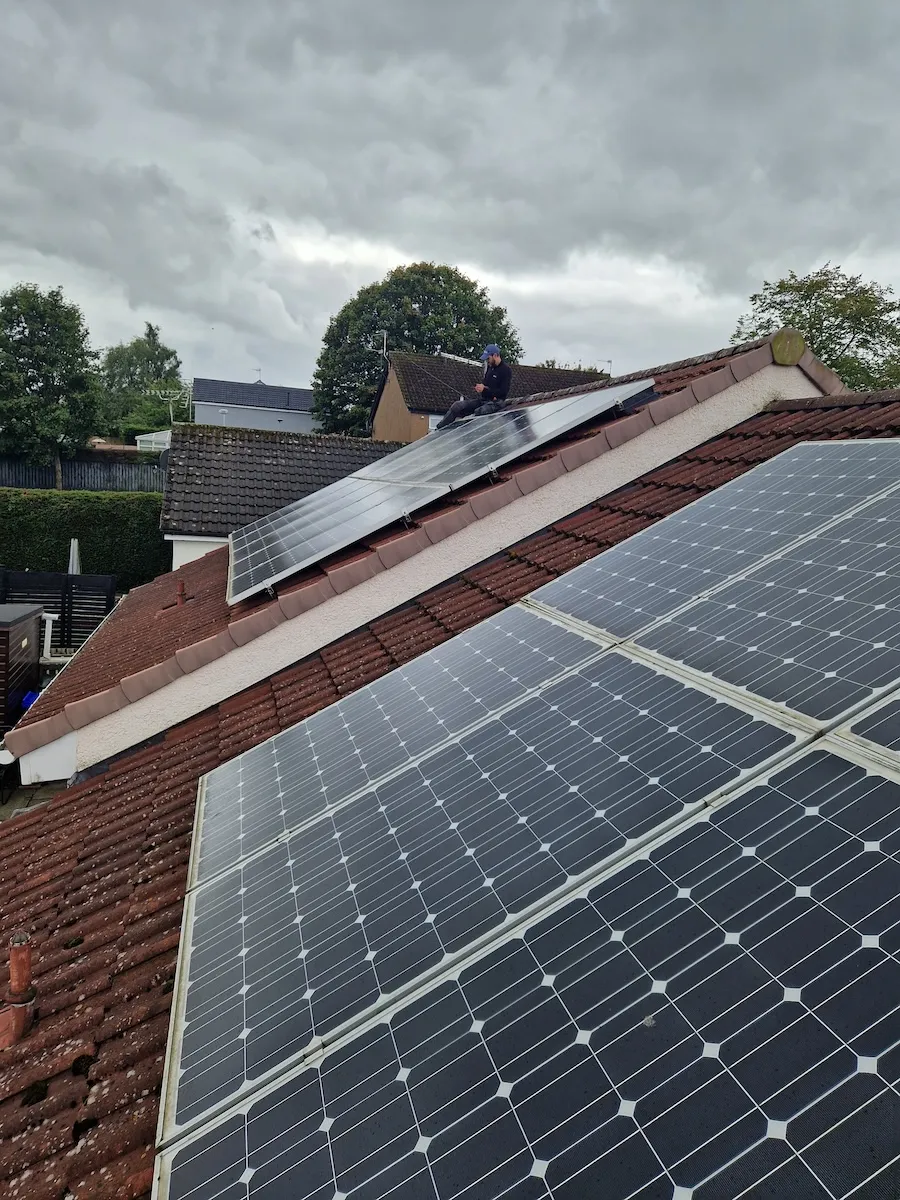
It starts with what you've seen. Photos of the roof, how long the birds have been there and a look at your monitoring help us plan the access and judge how much clearing out there will be.
On the roof, we check whether a nest is active. If it isn't, we clear the nest material and droppings from under and around the array. Where the glass is badly soiled we can clean the panels at the same visit, using a method that suits the panel and the access. While the space is open we look at the cable runs, connectors, fixings and any isolators we can see, and note anything that needs repaired.
Then the mesh goes on. We fit galvanised steel or stainless steel mesh around the full perimeter of the array, held with clips. It's secured without drilling into the panels or the roof. That matters for the panel warranty as much as for the roof: JA Solar's manual, for example, says not to drill holes in the panel frame because it can weaken the frame and cause corrosion, and that failing to follow the manual invalidates its limited module warranty. Other manufacturers have their own rules, so check the manual for the panels on your roof.
Before we leave, we check the system is generating and tell you about anything we found.
At Malcolm's in Stirling, the main job was repairing a solar and battery system the original installer had left not working properly. Once that was sorted, he asked us to fit bird blockers to his array and to his brother's system next door as well.
New installs and retrofits
Mesh can go on when the panels are installed or be added years later. Fitting it during the installation is cheaper, because the scaffolding is already up. On our Cambuskenneth installation in Stirling, a 12.42 kWp system with Sigenergy battery storage, bird protection was fitted as part of the job.
A retrofit usually comes after the birds have already moved in, so the array needs cleared out before the mesh goes on, and access has to be arranged separately.
DIY bird proofing and why we'd leave it
Solar panels have no off switch. JA Solar's manual notes that panels can only be made inoperative by taking them out of the light or covering the front completely, so the cables and connectors under the array are live with DC voltage whenever there's daylight on the panels. Pulling nest material out from round live connectors while working at height on a pitched roof isn't a job for a ladder and a pair of gloves.
Mesh that isn't secured properly can work loose in high winds, and a gap at a corner leaves the birds a way back in. If you've already tried spikes or deterrents and the birds are still getting under, it's worth having the array looked at properly.
What affects the price
We don't publish a fixed price for bird proofing, because two jobs rarely look the same. We price it after we've seen the roof. The number of panels, and how many separate arrays or roof faces they're spread over, sets how much mesh goes on. Access matters too: a bungalow roof is a different job from a three-storey gable that needs scaffolding or other access equipment to reach safely. After that, it depends how much nest material and droppings need cleared out, whether the panels need cleaned at the same visit, and whether the electrical checks turn up anything that needs repaired.
Your quote should list what's included, so you can see the clearing, cleaning and mesh separately from any repair work.
Bird proofing questions
What to send us
Start a solar maintenance enquiry with your postcode and how long you've noticed the birds. Keep a photo or two of the roof ready, showing the array and the gutter below it, as they help us plan the access. Tell us if you can see or hear chicks, how many storeys the house is, and whether there's anything that makes access awkward, such as a conservatory or a steep drop at the back. A screenshot of recent generation from your app helps us spot anything else worth checking. If the panels were fitted by another company, that's fine; send the inverter make and model if you have it.
Our solar panel maintenance guide covers cleaning and routine checks more generally.
Get the birds out from under your panels
Tell us what you've noticed on the roof. We'll check the timing, plan the access and price the clear-out, checks and mesh before any work starts.
Related Articles
Continue reading with these similar topics
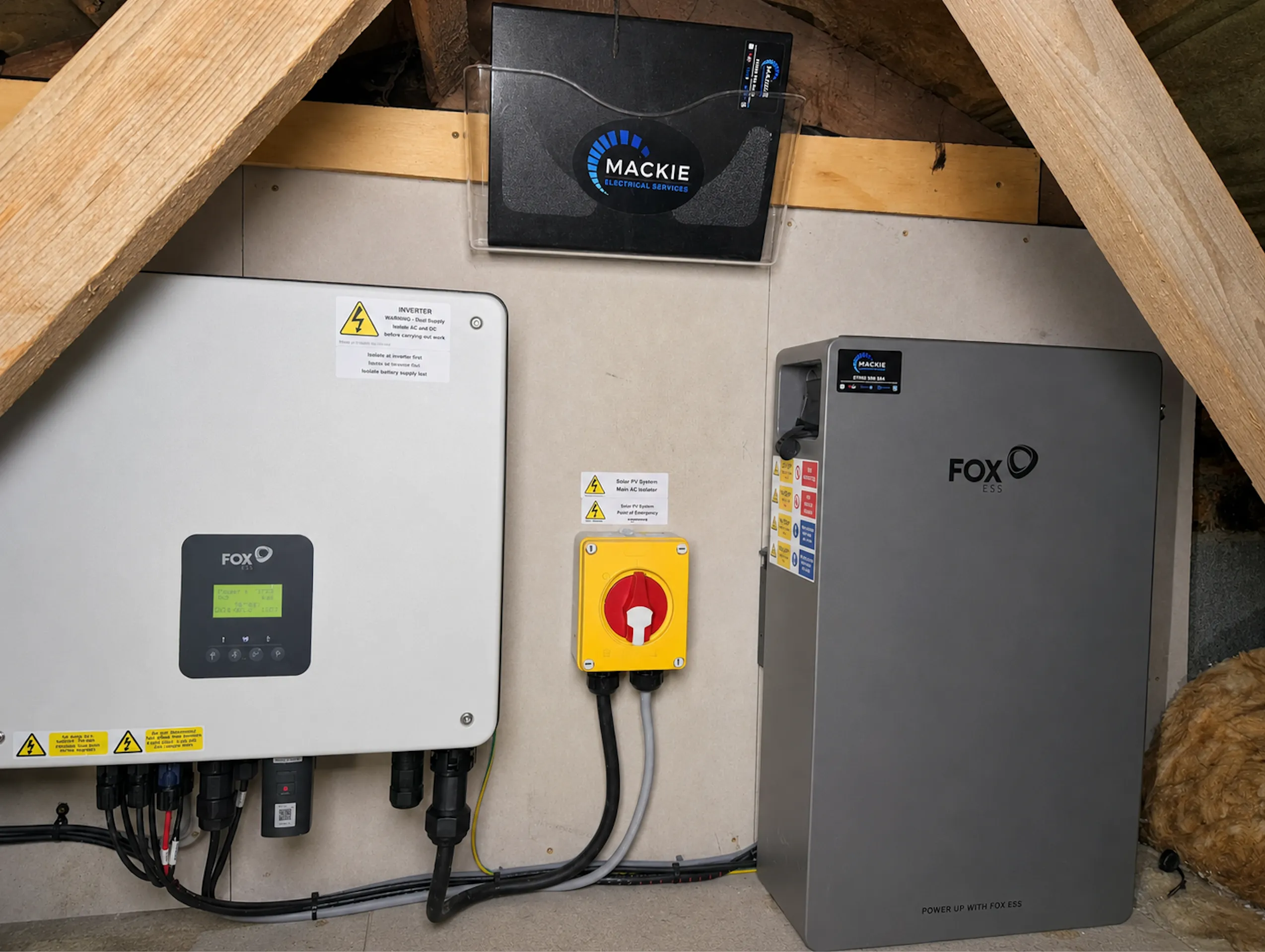
Solar Panels Not Generating? What to Check Before You Assume Something Has Failed
Solar panels showing zero generation? Check the app, inverter, power supply, shading and warning signs before assuming equipment has failed.
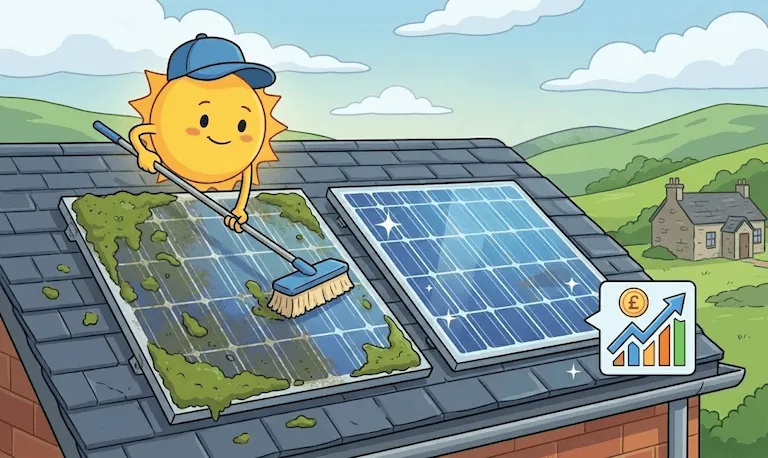
Solar Panel Maintenance in Scotland: Cleaning, Checks and Repairs
Practical solar panel maintenance advice for Scottish homes. Learn when cleaning helps, which faults need an installer and what to send before a repair visit.
Is Commercial Solar in Scotland Worth your Investment?
Straight-talking guide for Scottish businesses on commercial solar PV: DNO approvals (G98/G99), SSEN vs SPEN differences, export limiting, structural checks, finance, timelines, and payback.